Your computer name is shown at the top of Settings > System > About on both Windows 11 and Windows 10, and typing hostname in Command Prompt prints it in one line.
This guide covers every place Windows shows the name, how to see the domain or workgroup, the location settings that decide where your PC appears on a map, and how to rename the PC without breaking anything.
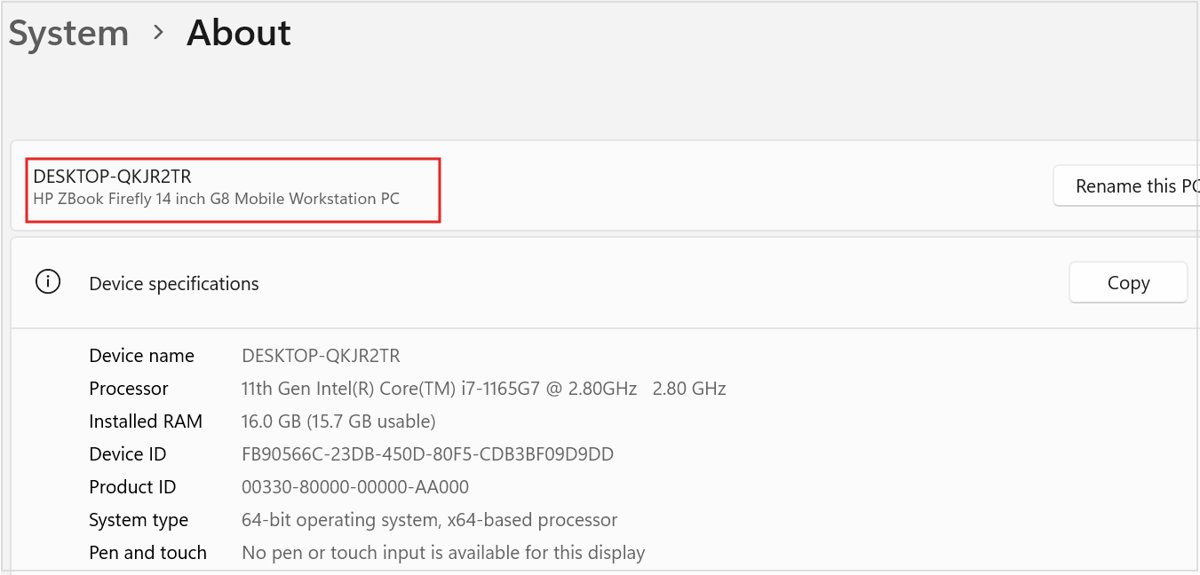
The fastest way to find your computer name
On Windows 11 one key combination opens the right page directly. On Windows 10 the Settings route takes three clicks.
- Press Windows logo key + Pause. On Windows 11 this opens Settings at System > About.
- On Windows 10, right-click Start, select Settings, then select System > About.
- Read the device name at the top of the page. The model name is shown just below it.
No Pause key on your keyboard? Press Windows logo key + R, type ms-settings:about and press Enter. It opens the same page.
Which method should you use?
Every route below reads the same name. Pick the one that also gives you the extra detail you need.
| Your situation | Use this | Why |
|---|---|---|
| You just need the name | Settings > System > About | Works the same on Windows 11 and Windows 10 |
| You are already in a terminal or writing a script | hostname or echo %COMPUTERNAME% |
Prints the name as plain text you can copy |
| You need to know if the PC is on a domain or in a workgroup | Control Panel > System > Computer Name tab | Shows the name and the domain or workgroup together |
| IT support wants a full hardware report | System Information (msinfo32) |
The name plus hardware and software details, exportable to a file |
| You also need the IP address | ipconfig in Command Prompt |
Lists the IPv4 and IPv6 addresses of each adapter |
| You lost the laptop and want to see where it is | Find My Device at account.microsoft.com/devices | Shows the device on a map if the feature was on |
| Support asks for a serial number or hardware ID | Settings > System > About, or Device Manager | Those are different identifiers from the computer name |
Finding your IP address on Windows is covered in detail separately. For component IDs, see how to find the HWID in Windows 11.
Find Your Computer Name in Windows Settings
The About page is where Microsoft documents the device name for both versions, and it is also where you rename the PC.
- Right-click Start and select Settings.
- Select System in the sidebar on Windows 11, or the System tile on Windows 10.
- Scroll to the bottom and select About.
- Read the device name at the top of the page, with the model name below it.
- Check Device specifications on the same page for the processor, installed RAM and system type (32-bit or 64-bit).
- Check Windows specifications for the edition and version, which matter if you plan to join a domain.
Check the Full Computer Name with System Information
System Information collects hardware, component and software details in one window. It is the tool help desks ask for because the whole report can be saved to a file.
Microsoft's hostname reference describes the short name as the host name portion of the full computer name. On a domain PC the full name adds the domain suffix, such as PC01.corp.contoso.com.
- Press Windows logo key + R to open Run.
- Type
msinfo32and press Enter. Typingmsinfo32in the taskbar search box and selecting System Information works too. - Select System Summary at the top of the left pane.
- Read the computer's name in the list on the right, alongside the OS name, version and manufacturer.
- To keep a copy, run
msinfo32 /report %USERPROFILE%\Desktop\sysinfo.txtfrom Command Prompt; it saves the report as a text file on your desktop.
Microsoft recommends opening System Information as administrator for complete driver and service data: right-click it in search results and select Run as administrator. An administrator can also run msinfo32 /computer PC01 to read another PC on the network, given WMI permissions on that PC.
Use Control Panel to View PC Name, Domain, or Workgroup
The Computer Name tab of System Properties shows the name together with whether the PC belongs to a domain or a workgroup. The route to it differs between the two versions.
- Select Start, type
Control Paneland press Enter. - Set View by at the top right to Category.
- Select System and Security, then System.
- On Windows 11, select the Domain or workgroup link. On Windows 10, select Change settings next to Computer name, domain, and workgroup settings.
- Read the Computer Name tab. It shows the computer name and the domain or workgroup the PC belongs to.
- Select Cancel to close without changing anything.
The Change button on that tab switches between Domain and Workgroup under Member of. Domain join needs Windows Pro, Enterprise or Education and an administrator account, and it usually requires credentials from your IT team.
Find Your Computer Name with Command Prompt or PowerShell
Three one-line commands print the name. hostname works in both Command Prompt and PowerShell; the other two are specific to one shell.
hostname
echo %COMPUTERNAME%
$Env:COMPUTERNAME
hostname prints the host name portion of the full computer name and runs in either shell. echo %COMPUTERNAME% is the Command Prompt form and prints the same string in uppercase. $Env:COMPUTERNAME is the PowerShell syntax for reading the same environment variable. hostname only works when the TCP/IP protocol is installed on a network adapter, which is the default.
You should see: One line with the name, for example PC01. It matches the name on the About page, apart from letter case.
Need the name and IP address together? Run ipconfig after hostname; it lists the IPv4 and IPv6 address, subnet mask and default gateway for each adapter.
Check Network Location and Device Location Settings
"Location" means two things in Windows. The network location, now called the network profile type, controls whether other PCs on the network can see yours. Device location controls whether Windows, apps and Find My Device know where the PC physically is.
Windows works out physical location from GPS, nearby Wi-Fi access points and routers, cell towers, your IP address, or a default location you set.
| What you want to check | Windows 11 | Windows 10 |
|---|---|---|
| Whether the network is Public or Private | Settings > Network & internet > Wi-Fi (select the network) or Ethernet > Network profile type | Same path; select the connected network, then Network profile type |
| Whether location is on for the device | Settings > Privacy & security > Location > Location services | Settings > Privacy > Location |
| Which apps can see your location | Same page: Let apps access your location, then the per-app list | Same page: Allow apps to access your location, then the per-app list |
| The fallback location when Windows cannot detect one | Location page > Default location > Set default | Location page > Default location > Set default |
| Whether Find My Device is on | Press Windows logo key + R, type ms-settings:findmydevice, press Enter |
Same shortcut; the page sits in the Update & Security area |
Microsoft labels Public network (Recommended) as the right choice in most cases because it hides your PC from other devices. Choose Private network only on a network you trust, when you need file and printer sharing.
Seeing a "your location is currently in use" notice after turning these on is normal; what triggers the location-in-use notice is explained separately.
Find where a lost Windows PC is with Find My Device
Find My Device shows a lost or stolen PC on a map. It only works if it was turned on before the device went missing, you sign in with a personal Microsoft account (not a work or school account), your account is an Administrator, and location is on.
- On any browser, go to account.microsoft.com/devices and sign in with the same Microsoft account.
- Select the Find My Device tab.
- Choose the device by its computer name.
- Select Find to see a map with the device's location.
- To lock it, select Lock > Next, then reset your Microsoft account password.
Anyone using the PC sees a notification each time you locate it. The serial number for a police or insurance report is on the same site under Info and support.
Choose a valid computer name
Pick the new name before you rename. Windows rejects names that break these rules, and names that pass can still clash with other devices on the network.
| Rule | Detail | Source of the limit |
|---|---|---|
| Length | 1 to 15 characters. The 16th NetBIOS character is reserved, so keep the name to 15. | NetBIOS name limit |
| Safe characters | Letters A-Z, numbers 0-9 and the hyphen (-) | DNS host name rules (RFC 1123) |
| Not allowed | Spaces, periods and \ / : * ? " < > | , ~ ! @ # $ % ^ & ' ( ) { } _ | NetBIOS and DNS rules combined |
| First and last character | Start with a letter or number; do not end with a hyphen | DNS host name rules |
| Numbers only | Not allowed on a PC that joins an Active Directory domain | DNS restriction |
| Uniqueness | Use a different name for every PC on the same network | Duplicate names cause conflicts |
Microsoft's advice is a short, memorable name that says who owns the PC or what it is for, such as ALEX-LAPTOP or OFFICE-PRINTPC. Letter case is not preserved everywhere, so do not rely on it to mean anything.
Rename Your Windows 11 or Windows 10 Computer Safely
Renaming changes the label other devices on the network and your Microsoft account device list see, and it takes effect after a restart. On a work or school PC joined to a domain, ask IT first, because renaming a domain member needs domain administrator credentials.
- Save your work and close open files, because the change needs a restart.
- Open Settings and select System > About.
- Select Rename this PC.
- Type the new name and select Next.
- Select Restart now, or Restart later to apply the name at the next restart.
Rename from System Properties: open the Computer Name tab as described in the Control Panel section, select Change, type a new name in Computer name and select OK, then restart.
After renaming, mapped drives or shortcuts on other PCs that point to the old name (for example \\OLD-NAME\Share) need updating.
Rename with PowerShell or Command Prompt
Rename-Computer renames the local PC in one line. Open PowerShell as an administrator and replace NEW-NAME with your chosen name.
Rename-Computer -NewName "NEW-NAME" -Restart
Rename-Computer -NewName "NEW-NAME" -DomainCredential CONTOSO\Admin01 -Restart
The first line renames a home or workgroup PC and restarts it straight away; leave out -Restart to restart later yourself. The second is for a domain-joined PC, where Microsoft requires explicit domain credentials; you are prompted for the password. -NewName accepts letters, numbers and hyphens, with no spaces or periods and not all digits.
You should see: The PC restarts. After you sign in, hostname prints the new name.
How to check the new name took effect
The name only changes after the restart, so check once you are signed back in.
- Open Command Prompt and type
hostname. It should print the new name. - Open Settings > System > About and confirm the new name at the top.
- If the old name still shows, restart once more; Microsoft notes a restart is often required for the change to take effect.
- Go to account.microsoft.com/devices and check that the device list shows the name you expect.
Frequently Asked Questions
How do I find my computer name on Windows 11?
Press Windows logo key + Pause, or open Settings > System > About. The device name is at the top of the page, with the model name below it. Typing hostname in Command Prompt shows the same name.
How do I find my computer name on Windows 10?
Right-click Start, select Settings, then System > About. The device name is shown at the top of that page. You can also open Control Panel > System and Security > System, or type hostname in Command Prompt.
How do I find my computer name with CMD?
Open Command Prompt and type hostname, then press Enter. The name prints on the next line. Typing echo %COMPUTERNAME% also works and prints the same name in uppercase letters.
How do I find my computer name and IP address at the same time?
Open Command Prompt and run hostname, then ipconfig. The first prints the computer name, and the second lists the IPv4 and IPv6 address, subnet mask and default gateway for each network adapter.
How do I find my computer name on a Mac?
Choose Apple menu > System Settings, select General in the sidebar, then About. The computer name is at the top and you can edit it there. The local hostname used on the network is under General > Sharing, at the bottom of the window.
What is the difference between computer name and full computer name?
The computer name is the short host name, such as PC01. The full computer name adds the DNS domain suffix, such as PC01.corp.contoso.com. On a home PC in a workgroup there is no domain suffix, so the two are usually the same.
Where can I see whether my PC is in a domain or workgroup?
Open Control Panel > System and Security > System. On Windows 11 select Domain or workgroup; on Windows 10 select Change settings. The Computer Name tab shows the domain or workgroup the PC belongs to.
Does my Windows computer name show my physical location?
No. The computer name is only a label on the network. Physical location comes from Windows location services, which use GPS, Wi-Fi, cell towers or your IP address, and you control it in Settings under Privacy & security > Location.
Can I rename my Windows computer without causing problems?
Yes, on a home PC. Use Settings > System > About > Rename this PC, pick a name of 15 characters or fewer with letters, numbers and hyphens, then restart. Update any mapped drives that use the old name, and ask IT first on a domain-joined work PC.
Bottom Line
Use Settings > System > About (or Windows logo key + Pause on Windows 11) to read your computer name, and hostname when you are already in a terminal. Both show the same name on Windows 11 and Windows 10 without admin rights. Go to the Control Panel Computer Name tab only when you need the domain or workgroup, and check Privacy & security > Location plus Find My Device if you want Windows to know where the PC physically is.

How to Rename PC in Windows 11 (Change Computer Name) - Techdows
[…] For every other place the name shows up, including System Information and the network, see how to find your computer name and location on Windows 11/10. […]
How to Find Your Files on iPhone: A Step-by-Step Guide - Techdows
[…] To reach a computer or NAS, tap Browse, tap the More button, tap Connect to Server, then enter the hostname or network address. Looking that up first helps: see how to find your computer name and location on Windows 11/10. […]