Press Ctrl + H on Windows or Linux, or ⌘ + Y on a Mac, to open the Chrome History page and read every site you visited in the last 90 days.
The sections below cover the menu route, address-bar search, Android and iPhone, pages opened on your other devices, and what to do when an entry is missing.
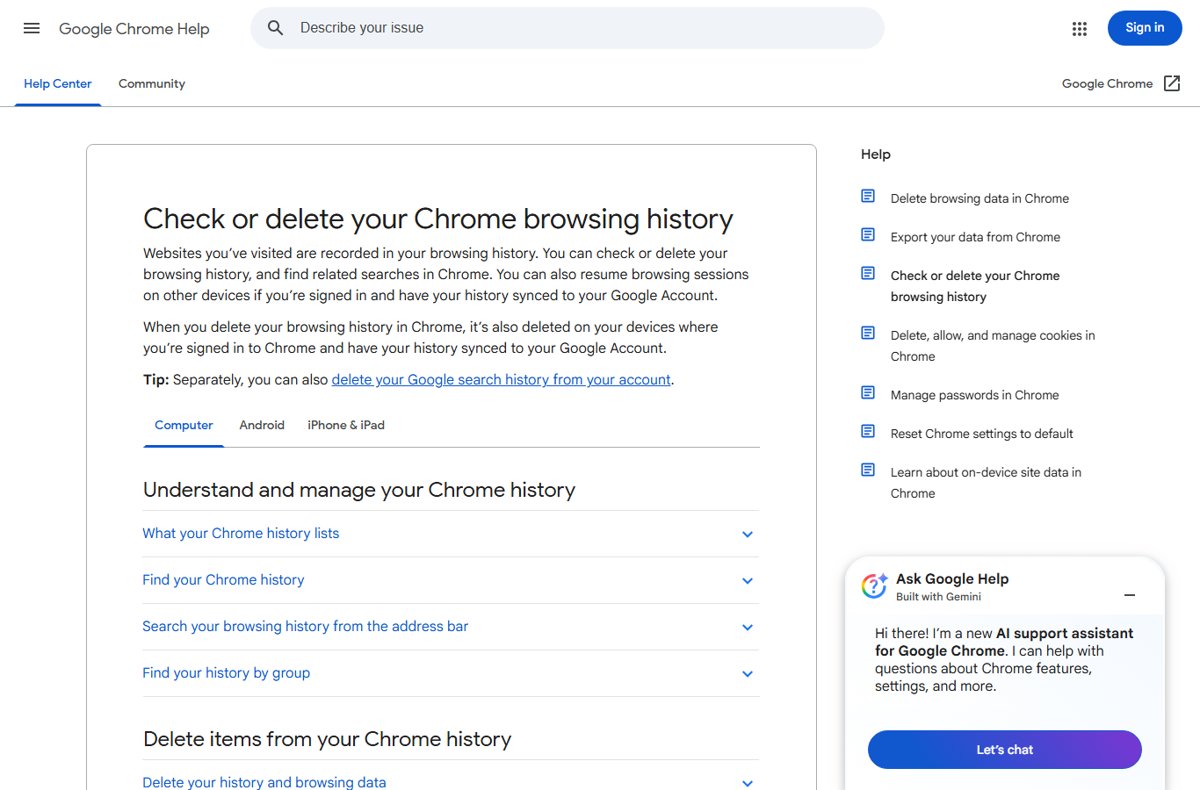
The fastest way to view your Chrome history
The History page opens in a new tab, newest visit first, with a search box across the top.
- Open Chrome on your computer.
- Press Ctrl + H on Windows or Linux. On a Mac, press ⌘ + Y.
- Type a word from the page title or web address into the search box to filter the list.
- Select the entry to reopen that page.
Prefer the mouse? Select More at the top right, point to History, then select History.
Methods to access Chrome history
Every route lands on the same record. Pick the row that matches where you are.
| Your situation | Use this | Why |
|---|---|---|
| Windows or Linux desktop | Ctrl + H | One keystroke, no menus |
| Mac desktop | ⌘ + Y | Same page, Mac shortcut |
| You remember a word from the page | Type @history in the address bar |
Searches history without opening a second tab |
| Android phone or tablet | More, then History | Chrome for Android has no keyboard shortcut |
| iPhone or iPad | More, then History | Same two taps, with a search bar at the top |
| A page you opened on another device | Tabs from other devices in the History page | Needs History and tabs sync turned on |
| Activity older than 90 days | My Activity in your Google Account | The Chrome History page only reaches back 90 days |
Viewing Chrome history using keyboard shortcuts
Four shortcuts cover reading, reopening and clearing history on the desktop.
- Press Ctrl + H (Windows, Linux) or ⌘ + Y (Mac) to open the History page.
- Press Ctrl + Shift + T (Windows, Linux) or ⌘ + Shift + T (Mac) to reopen the tab you closed last.
- Press Ctrl + J (Windows, Linux) or ⌘ + Shift + J (Mac) to open the Downloads page, which history does not list as page visits.
- Press Ctrl + Shift + Delete (Windows, Linux) or ⌘ + Shift + Delete (Mac) to open the delete browsing data dialog.
Open the History page from the Chrome menu
Use this route when a shortcut is taken by a web app or by an extension.
- Open Chrome on your computer.
- Select More at the top right.
- Point to History.
- Select History in the submenu.
- Narrow the list with the search box, the By date filter or the By group filter.
Search your browsing history from the address bar
This finds a page without leaving the tab you are reading.
- Open Chrome and click in the address bar.
- Type
@history. - Press Tab or Space.
- Select Search History in the suggestions.
- Type a keyword from the page you are after.
- Select the page in the results.
View Chrome history on Android
- Open Chrome on your Android phone or tablet.
- Tap More at the top right. If your address bar sits at the bottom, swipe up on it first.
- Tap History.
- Type in the search box at the top to filter the list.
- Tap Remove to the right of an entry to delete only that page.
- Touch and hold an entry to select several, then tap Remove at the top right.
View Chrome history on iPhone and iPad
- Open Chrome on your iPhone or iPad.
- Tap More.
- Tap History.
- Type in the search bar at the top of the History view to find one page.
- Tap Edit at the bottom, tick the entries you want gone, then tap Delete.
- Tap Done at the top right.
See history and tabs from your other devices
Chrome shows pages from your phone or second computer once History and tabs is synced to the same Google Account.
- Open Chrome on your computer.
- Select More, then Settings, then You and Google.
- Select your account name and turn on History and tabs.
- Sign in to the same Google Account on the other device and turn the same setting on there.
- Open the History page and select Tabs from other devices on the left.
If you set a sync passphrase, only sites whose addresses you typed into the address bar appear from other devices.
Understanding Chrome history
Knowing what the list leaves out saves a long search for an entry that was never recorded.
| Question | What Chrome does |
|---|---|
| How far back does it go? | Pages from the last 90 days |
| What is recorded? | The page title and web address of each site you visited |
| Chrome's own pages | Not listed, for example chrome://settings |
| Incognito windows | Never recorded in history |
| Other devices | Included when you are signed in and History and tabs is synced |
| Entries you delete | Removed from the list, and from your other synced devices too |
Managing and searching your Chrome history
The History page has two views and a search box, and it deletes entries one at a time or by time range.
- Open the History page with Ctrl + H or ⌘ + Y.
- Type a word from the page title or web address into the search box to filter the list.
- Select By date to read straight down the timeline.
- Select By group to see pages Chrome grouped by topic, then select a group to open its pages as a tab group.
- Tick the boxes next to entries you no longer want, select Delete at the top right, then select Remove.
- To clear a stretch of time instead, select More, then Delete browsing data, pick a time range, tick Browsing history and select Delete data.
Grouped entries are the same feature techdows covered when Chrome started folding Memories into the History page, and the selection boxes respond to Ctrl+A on the history page.
Search your Chrome history with AI
History search, powered by AI answers a plain-language question instead of matching a keyword.
It is available in the United States with Chrome set to English, and an organization can switch it off on a managed profile.
- Select More, then Settings, then AI Innovations.
- Select History search, powered by AI and turn it on.
- Open the History page and type a question of two or more words, as specific as you can make it.
- Read the results under Best matches from your browsing history, which shows up to three pages.
- Filter with Yesterday, Last 7 days or Last 30 days to narrow the answer.
Only pages you visit after turning the setting on can be matched this way, and their contents are stored encrypted on the device.
View your Chrome activity in your Google Account
Activity from Google services, Chrome among them, can be saved to your account separately from the browser's own 90-day list.
- Open your Google Account and select Data & privacy in the left panel.
- Under Personalization & activity, select My Activity.
- Browse by day and time, or use the search box and filters at the top.
- Select an entry to see the site or search it came from.
- Use the auto-delete option there to drop older activity on a schedule.
The direct address is myactivity.google.com, and techdows covers the account side of this in Search History: How to View or Delete It.
How to check it worked
- Look at the top of the History page: the newest entry should be the page you were on before you opened it.
- Type part of a site you visited today into the search box and confirm it appears.
- Select Tabs from other devices on the left; your other signed-in devices should be listed by name.
- Open an Incognito window, load any page, close it and reload History; that page must not be listed.
Troubleshooting common issues
The History page is empty
Browsing data was deleted, or the pages were opened in Incognito mode, which Chrome never records.
- Visit any site in a normal window, then reopen the History page with Ctrl + H or ⌘ + Y.
- Check whether Delete browsing data was run with Browsing history ticked and a wide time range.
- Confirm the window you were browsing in was not Incognito, which shows no History entries at all.
- Check you are in the Chrome profile you were browsing in, since each profile keeps its own history.
You cannot find a site you know you visited
The History page reaches back 90 days, and long search phrases match fewer entries.
- Search a single short word from the page title or the web address.
- Switch between By date and By group, because a grouped page can sit under a topic rather than a day.
- Type
@historyin the address bar and search again from there. - For anything older than 90 days, look in My Activity in your Google Account instead.
History from your other devices is missing
History and tabs sync is off on one device, or the devices are signed in to different Google Accounts.
- Select More, then Settings, then You and Google, and check the account name shown.
- Turn on History and tabs for that account.
- Sign in to the same account on the other device and turn the same setting on.
- Reopen Tabs from other devices on the History page.
- If you use a sync passphrase, expect only the sites whose addresses you typed into the address bar.
AI history search returns no best matches
The feature covers the United States with Chrome set to English, and only pages visited after it was switched on.
- Open Settings, then AI Innovations, and confirm History search, powered by AI is on.
- Search with two or more words and describe the page, rather than typing one keyword.
- Search for a page you visited after the setting was turned on.
- On a work or school profile, expect the option to be absent if the organization disabled it.
Privacy and security considerations
Treat the History page as a shared record rather than a private one. Anyone who can open your signed-in Chrome profile can read it, deleting an entry also deletes it on every device where History and tabs is synced, and the activity saved to your Google Account survives a deletion made in the browser.
Grant history access to extensions sparingly: techdows has reported on a history extension that turned out to be malicious.
Final thoughts
Use Ctrl + H or ⌘ + Y for anything inside 90 days, and My Activity for anything older. The History page is the only view that carries Chrome's search box, the By group filter and Tabs from other devices, while your Google Account holds the record that outlives Chrome's 90-day window.
Frequently asked questions
How do you view Chrome history?
Press Ctrl + H on Windows or Linux, or Command + Y on a Mac. You can also select More at the top right, point to History and select History. The page lists the sites you visited in the last 90 days, newest first.
How do you check Chrome history on a phone?
Open Chrome on Android, iPhone or iPad, tap More, then tap History. On Android, swipe up on the address bar first if it sits at the bottom of the screen. Both apps put a search box at the top of the History view.
How do you see search history on Chrome?
Searches you ran from the address bar appear as entries on the Chrome History page, so the search box there finds them. Searches saved to your Google Account are listed separately in My Activity at myactivity.google.com.
Where is the Chrome history file?
Chrome keeps history in a database inside the profile folder it is running from, and it holds that file open while the browser is running. There is no supported way to read it directly, so use the History page or export a copy of your data from your Google Account.
How do you find browsing history in Chrome without a keyboard?
Select More at the top right of the Chrome window, point to History, then select History. On a touchscreen, tap the same three-dot menu. No keyboard shortcut is needed and the page that opens is identical.
How far back does Chrome history go?
The Chrome History page lists pages from the last 90 days. Older visits are not shown there. Activity saved to your Google Account is held separately and can be reviewed in My Activity, where you can also set it to auto-delete.
Does Incognito browsing show in Chrome history?
No. Pages opened in an Incognito window are never added to the Chrome History page, and Chrome's own pages such as chrome://settings are left out as well. Only normal-window visits appear in the list.
How do you look at Chrome history from another device?
Sign in to the same Google Account on both devices and turn on History and tabs under Settings, You and Google. Then open the History page and select Tabs from other devices on the left to see what is open elsewhere.
Can you view Chrome history after it is deleted?
Not in Chrome. Deleting browsing history removes it from the History page and from every device where History and tabs is synced. Activity that Chrome saved to your Google Account may still be listed in My Activity until you delete it there too.