Turn on Windows 11 dark mode in Settings > Personalization > Colors by setting Choose your mode to Dark.
This guide also covers dark mode in File Explorer, Edge, Chrome, Office and YouTube, how to force it with contrast themes, how to schedule it, and what to do when some apps stay light.
How to Enable Dark Mode in Windows 11 Settings
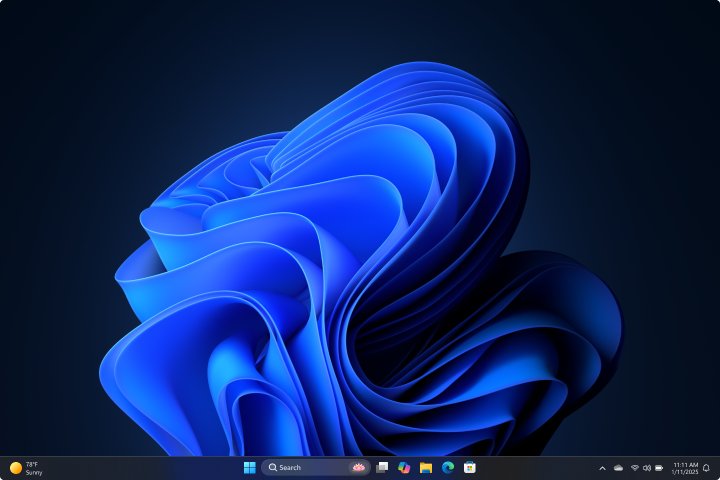
This one setting darkens Start, the taskbar, Settings and every app that follows the Windows theme.
- Select Start, then open Settings.
- Select Personalization in the left pane.
- Select Colors.
- Open the Choose your mode list and select Dark.
- Close Settings. The change applies immediately, with no restart.
To jump straight to the page, press Windows + R, type ms-settings:colors and press Enter. Select Custom instead of Dark if you want dark apps with a light taskbar, or the reverse.
What Windows 11 Dark Mode Actually Changes
Dark mode is a color mode, not a filter. Windows swaps its own surfaces to dark colors and tells apps which mode you prefer. Apps decide whether to follow it.
| Part of Windows | Dark | Light | Custom |
|---|---|---|---|
| Start menu, taskbar, action center | Dark | Light | Your choice for Windows |
| Settings, File Explorer and other Windows apps | Dark | Light | Your choice for apps |
| Accent color on Start and taskbar | Available | Not available | Available when Windows is set to dark |
| Third-party apps and websites | Only if the app follows the system theme | Unchanged | Follow the app choice, if supported |
| Documents, photos and videos | Unchanged | Unchanged | Unchanged |
Microsoft lists dark mode among its power-saving settings because it reduces screen power use, especially on OLED displays. On a standard LCD panel the saving is smaller.
Which dark mode method should you use?
| Your situation | Use this | Why |
|---|---|---|
| You want Windows and apps dark | Personalization > Colors > Dark | One setting, applies instantly |
| You want dark apps but a light taskbar, or the reverse | Colors > Custom | Sets Windows and apps separately |
| You want dark wallpaper, colors and sounds in one click | A dark theme in Personalization > Themes | Switches several settings at once |
| A browser or Office stays light | The app's own theme setting | These apps can override the Windows mode |
| You need every window and web page dark, including stubborn ones | A contrast theme | Recolors almost all text backgrounds, web pages included |
| You want dark at night and light by day | PowerToys Light Switch | Windows Settings has no built-in schedule for dark mode |
Enable Dark Mode Using a Windows 11 Theme
A theme bundles a desktop background, window colors, sounds and a mouse cursor. Applying a dark theme sets the color mode and a matching wallpaper together.
- Open Settings and select Personalization > Themes.
- Look at the theme previews and pick one with a dark taskbar and window.
- Select the theme to apply it.
- For more choices, select Browse themes to get free themes from the Microsoft Store.
- To keep your own combination, select Save and give the theme a name.
Right-click a saved theme and select Save theme for sharing to create a .deskthemepack file you can copy to another PC.
Make the Taskbar, Start Menu, and Accent Colors Look Right
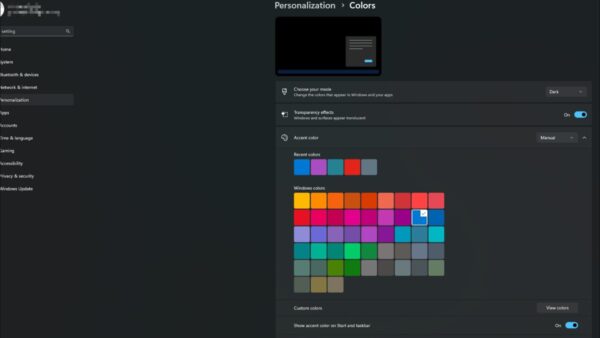
Dark mode alone leaves Start and the taskbar a neutral dark gray. The accent color options on the same Colors page add your color to them.
- Open Settings > Personalization > Colors.
- Confirm Choose your mode is Dark or Custom. The Start and taskbar accent option is not available in Light mode.
- Under Accent color, select Automatic to take a color from your wallpaper, or Manual to pick one.
- With Manual, choose a color under Recent colors or Windows colors, or select View colors for a custom shade.
- Turn on Show accent color on Start and taskbar to tint those surfaces.
- Turn on Show accent color on title bars and window borders to color the top bar and edge of each window.
- Switch Transparency effects on or off. On adds a slight acrylic blur behind some surfaces.
Enable Dark Mode in File Explorer
File Explorer has no theme switch of its own. It follows the app side of the Windows color mode, so the fix is on the Colors page.
- Open Settings > Personalization > Colors.
- Set Choose your mode to Dark.
- If you use Custom, set the app mode to dark. The Windows mode only controls Start and the taskbar.
- Close any open File Explorer windows.
- Press Windows + E to open File Explorer again and check it is dark.
Turn on Dark Mode in Microsoft Edge
Edge has its own appearance setting, so it can stay light even when Windows is dark.
- In Microsoft Edge, select Settings and more (the three dots) > Settings.
- Select Appearance in the Settings menu.
- In the Overall appearance section, select Dark.
This darkens the toolbar, tabs, menus and Edge's own pages. It does not recolor websites. For dark web pages, see the website section below.
Turn on Dark Mode in Google Chrome
Chrome calls this Dark mode on desktop. It darkens the homepage, toolbar, settings and some other Chrome pages.
- Open a New Tab page in Chrome.
- At the bottom right, select Customize Chrome.
- Under Appearance, select Dark to keep Chrome dark at all times.
- Or select Device so Chrome follows the Windows color mode.
Incognito windows can look dark even when Chrome is set to Light. That is Incognito's own styling, not a theme change. Older background is in how Chrome on Windows picked up dark mode.
Turn on YouTube Dark Mode on your computer
YouTube stores its theme per browser, separate from Windows and Chrome. It is also the setting that unlocks Ambient mode, which needs Dark theme turned on first.
- Open YouTube in your browser and sign in if you want.
- Click your profile picture at the top right.
- Click Appearance.
- Select Dark theme.
- To match Windows instead, select Use device theme.
Enable Dark Mode in Microsoft Office Apps
Office uses one theme for Word, Excel, PowerPoint, Outlook and the other desktop apps. Setting it once in Word covers all of them.
- Open Word and go to File > Account.
- Open the Office Theme list.
- Select Black for permanent dark mode in all Office apps.
- Or select Use system setting so Office switches with your Windows mode.
- In a document, go to the View tab and select Switch Modes to flip the page between dark and light.
- To keep the page white while menus stay dark, go to File > Options > General, check Never change the document page color, and select OK.
Documents always print with a light page, and your dark setting does not change what collaborators see. The setting does not carry over between Word for Windows, Mac and the web.
Enable Dark Mode in Popular Windows Apps
Most modern Windows apps follow the system theme by default. The table shows where the setting lives in apps that keep their own.
| App | Where to set dark mode | Follows Windows by default? |
|---|---|---|
| Windows Terminal | "theme": "dark" in settings.json, or the Theme appearance setting |
Yes, the default value is system |
| Settings, File Explorer and other Windows apps | Settings > Personalization > Colors | Yes |
| Microsoft Edge | Settings > Appearance > Overall appearance > Dark | Has its own setting |
| Google Chrome | Customize Chrome > Appearance > Dark or Device | Only when set to Device |
| Word, Excel, PowerPoint, Outlook | File > Account > Office Theme > Black | Only with Use system setting |
| YouTube in a browser | Profile picture > Appearance > Dark theme | Only with Use device theme |
| WhatsApp for Windows | See WhatsApp dark mode on Windows 11/10 | Depends on the app version |
| Notepad++ | See Notepad++ dark mode on Windows 11 | Has its own setting |
For any other app, such as a chat or music player, look for Theme or Appearance in its own settings. Not every app supports dark mode.
Force Dark Mode with High Contrast Themes
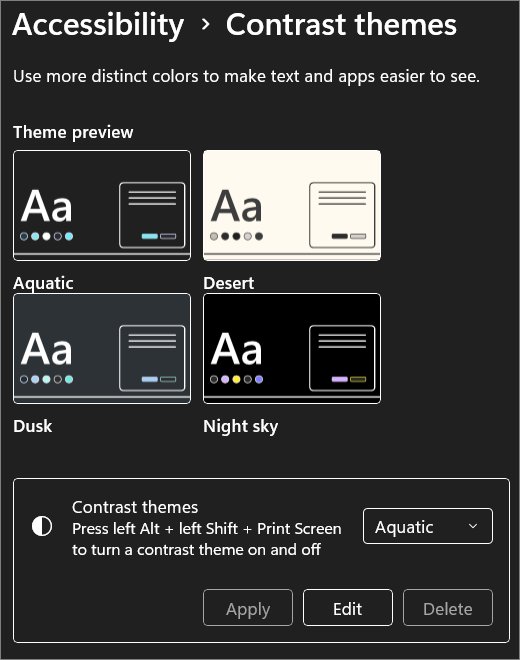
Windows 11 calls these contrast themes. Unlike dark mode, a contrast theme recolors the background and text of nearly everything, including web pages and older apps that ignore dark mode.
- Select Start > Settings > Accessibility > Contrast themes.
- Open the Contrast themes drop-down and pick a theme with a dark background.
- Select Apply. Windows may show a Please wait screen for a few seconds.
- To tune it, select Edit and change Background, Text, Hyperlinks, Inactive Text, Selected Text or Button Text.
- Select Save as, name the theme, then select Save and apply.
- To turn it off, pick None in the drop-down and select Apply.
Press left Alt + left Shift + Print Screen to toggle high contrast on or off without opening Settings. Contrast themes change colors sharply and can make images and page layouts look odd, so they suit accessibility needs more than taste.
Force Dark Mode Using Registry Settings
Microsoft does not document a registry value for home users to switch dark mode. Registry tweaks passed around online are unofficial, and the Colors page does the same job safely.
| Route | Documented by Microsoft? | Who it is for |
|---|---|---|
| Settings > Personalization > Colors | Yes | Everyone |
Unattend setting Microsoft-Windows-Shell-Setup | Themes | UWPAppsUseLightTheme |
Yes. false applies dark mode, true keeps the default |
IT admins and PC builders deploying Windows |
| Hand-edited registry values | No | Not recommended |
The unattend setting is valid in the specialize, auditSystem, auditUser and oobeSystem configuration passes. It sets the starting mode for new installs; users can still change it afterwards in Settings.
Schedule Dark Mode Automatically
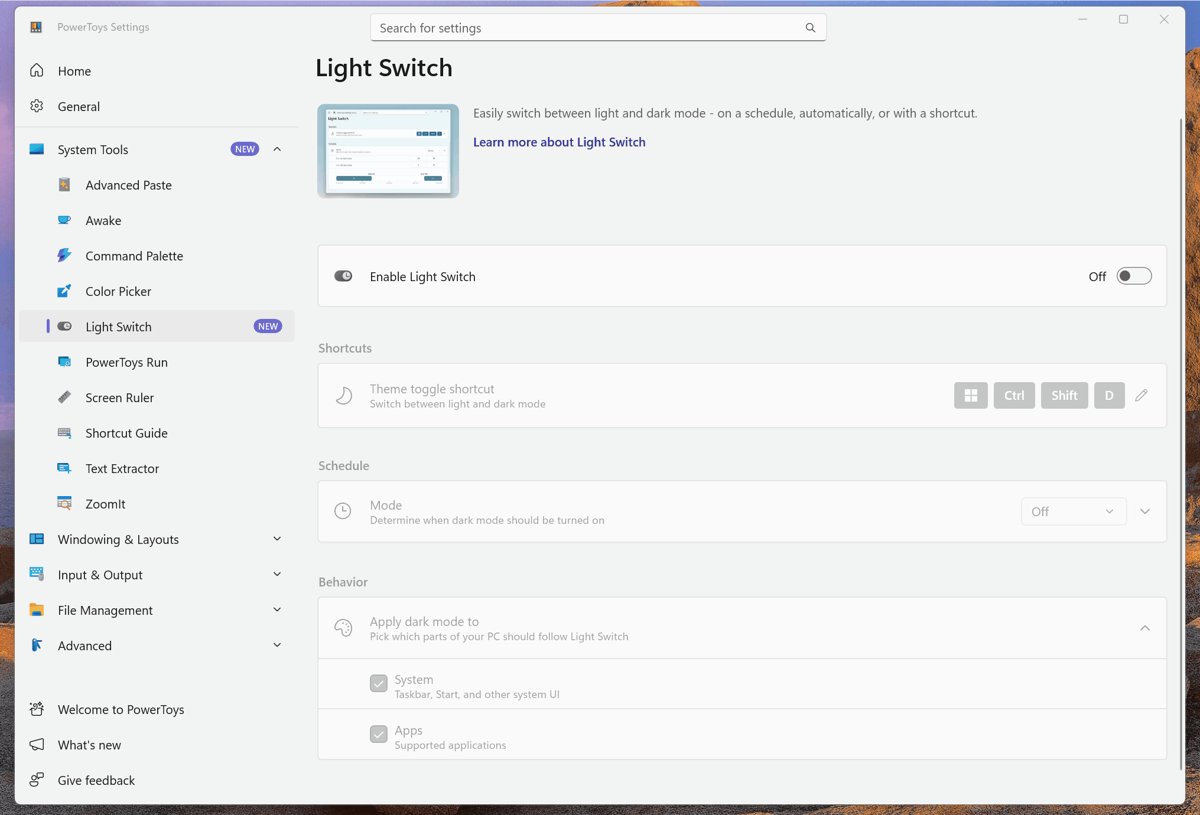
The Colors page has no schedule. Microsoft's own tool for this is Light Switch, a free utility inside Microsoft PowerToys.
- Install Microsoft PowerToys, then open PowerToys Settings.
- Select Light Switch and turn on Enable Light Switch.
- Under Schedule Mode, choose Sunset to Sunrise, Fixed hours or Follow Night Light.
- For Sunset to Sunrise, turn on location services or enter your coordinates under Location.
- For Fixed hours, set Turn on dark mode and Turn on light mode times.
- Under Apply dark mode to, choose System, Apps or both.
- Optionally set a Theme toggle shortcut to switch modes by keyboard.
Use Offset in minutes to switch earlier or later than sunset and sunrise. The Light Switch documentation lists every option.
Use Night Light Alongside Dark Mode
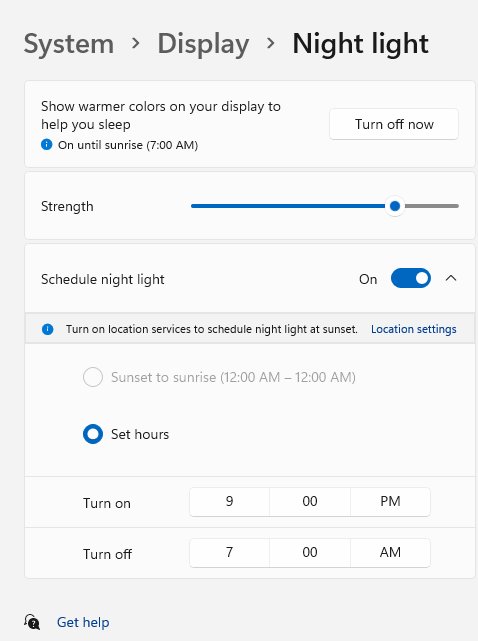
Dark mode changes colors; Night light warms the whole screen to cut blue light. They work together, and Light Switch can follow the Night light schedule.
- Select Start > Settings > System > Display.
- Turn on Night light.
- Select Night light to open its settings.
- Move the Strength slider to set how warm the screen gets.
- Turn on Schedule night light, then select Sunset to sunrise or Set hours.
Night light also sits in Quick Settings: select the network or speaker icon on the taskbar and toggle it there. It is not available with DisplayLink or Basic Display drivers.
Make Websites Dark Without Browser Flags
Browser dark mode darkens the browser frame, not the pages. Neither Google's Chrome help nor Microsoft's Edge help documents a force-dark flag for desktop, so treat flags you see online as unsupported experiments.
| What you want dark | Supported way to do it | Limit |
|---|---|---|
| Sites that have their own dark theme | Pick the dark option in the site, or its device-theme option | Only works where the site offers it |
| Sites that follow your system theme | Set Windows and the browser to dark, or Chrome to Device | Sites without a dark design stay light |
| Every web page, no exceptions | A contrast theme in Accessibility > Contrast themes | Recolors everything, not just dark |
| Testing how a page looks darkened | Chrome DevTools Rendering > Emulate auto dark mode | Developer tool, affects the open tab only |
Google's documented Auto Dark Theme for websites is an Android feature, not a desktop one. Earlier desktop experiments are covered in dark mode for all websites in Chrome Canary.
Why Some Windows 11 Apps Stay Light
| Cause | What you see | What to change |
|---|---|---|
| Custom mode has apps set to light | Taskbar is dark, windows are white | Set the app mode to dark on the Colors page |
| The app has its own theme setting | Edge, Chrome or Office stays light | Set that app to dark or to follow the system |
| The app has no dark mode | Some older programs and dialogs stay white | Use a contrast theme, or accept it |
| Word keeps a light page | Menus are dark, the page is white | Clear Never change the document page color, or use Switch Modes |
| Some Office parts do not map to dark | Charts, text boxes or side panes stay light | A known Word limitation; no setting fixes it |
How to check dark mode is working
- Look at the Settings window itself. Its background should now be dark gray.
- Select Start. The menu and the taskbar should be dark.
- Press Windows + E. File Explorer should open with a dark background.
- Open Edge or Chrome. If the toolbar is still light, set the browser's own appearance setting.
- Open Word. If the ribbon is light, check File > Account > Office Theme.
How to turn off dark mode in Windows 11
- Open Settings > Personalization > Colors.
- Set Choose your mode to Light.
- If a contrast theme is on, go to Accessibility > Contrast themes, select None and select Apply.
- If PowerToys Light Switch is installed, set Schedule Mode to Off or turn off Enable Light Switch.
- Set Edge, Chrome, Office or YouTube back to Light if you changed them separately.
Troubleshooting: Dark Mode Is Not Working
Windows 11 keeps changing to dark mode on its own
A schedule or a theme is switching the mode for you.
- Open PowerToys and check Light Switch. Set Schedule Mode to Off if you do not want automatic changes.
- Open Settings > Personalization > Themes and check which theme is applied.
- Apply a theme with a light preview, or save your current setup as a theme so it can be reapplied.
- Check Accessibility > Contrast themes. The left Alt + left Shift + Print Screen shortcut can turn one on by accident.
Windows 11 is in dark mode and you did not turn it on
The mode, a theme or a contrast theme was set during setup or by another user.
- Open Settings > Personalization > Colors and set Choose your mode to Light.
- If colors look harsh rather than dark gray, a contrast theme is on. Set it to None and select Apply.
- On a work or school PC, ask your IT admin. The starting mode can be set when Windows is deployed.
Taskbar and Start stay light while apps go dark
Custom mode is on with the Windows mode set to light.
- Open Settings > Personalization > Colors.
- Check whether Choose your mode says Custom.
- Set the Windows mode to dark, or pick Dark to set both at once.
Dark mode is on but one app stays light
The app uses its own theme setting or does not support dark mode.
- Close the app completely and open it again.
- Open the app's settings and look for Theme or Appearance.
- Set it to dark, or to follow the system or device theme.
- For File Explorer, close every Explorer window and press Windows + E to reopen it.
- If the app has no theme option, use a contrast theme or leave it light.
Frequently Asked Questions
Does Windows 11 have dark mode?
Yes. Windows 11 has a built-in dark mode in Settings > Personalization > Colors. Set Choose your mode to Dark and Start, the taskbar, Settings, File Explorer and apps that follow the system theme turn dark immediately.
What is Windows 11 dark mode?
Windows 11 dark mode is a color mode that swaps light backgrounds for dark gray ones across Windows and supported apps. It is designed for low-light rooms and can reduce screen power use on OLED displays. It does not recolor documents, photos or most websites.
How do I turn on dark mode in Windows 11?
Select Start > Settings > Personalization > Colors, then set Choose your mode to Dark. The change is instant and needs no restart. Pick Custom instead to make apps dark while keeping a light taskbar, or the other way round.
Can I change Windows 11 to dark mode only for apps?
Yes. On the Colors page, set Choose your mode to Custom. Custom mode lets you choose light or dark separately for Windows surfaces, such as Start and the taskbar, and for apps such as File Explorer and Settings.
How do I turn off dark mode in Windows 11?
Open Settings > Personalization > Colors and set Choose your mode to Light. If the screen still looks dark, check Accessibility > Contrast themes and select None, then turn off any PowerToys Light Switch schedule.
Why is Windows 11 in dark mode?
Windows 11 is in dark mode because Choose your mode is set to Dark, a dark theme was applied, or a schedule such as PowerToys Light Switch switched it. A contrast theme turned on by the left Alt + left Shift + Print Screen shortcut can also darken the screen.
Is there a keyboard shortcut for Windows 11 dark mode?
Windows 11 has no built-in shortcut for dark mode. PowerToys Light Switch lets you set a Theme toggle shortcut that flips between light and dark. The built-in left Alt + left Shift + Print Screen shortcut toggles high contrast, which is a different feature.
Can Windows 11 switch to dark mode automatically?
Not from Settings alone. Microsoft's PowerToys Light Switch utility schedules dark mode from sunset to sunrise, at fixed hours, or in step with the Night light schedule, and can apply it to the system, apps, or both.
Is there a registry setting for Windows 11 dark mode?
Microsoft does not document a registry value for users to switch dark mode. The documented options are the Colors page in Settings and, for IT deployments, the UWPAppsUseLightTheme unattend setting, where false applies dark mode.
How do I enable YouTube dark mode on a computer?
Click your profile picture on YouTube, click Appearance, and select Dark theme. Select Use device theme instead to follow your Windows or browser setting. Dark theme must be on before you can use YouTube's Ambient mode.

![Dual boot Linux Mint and Windows 10 or 11 [beginner’s guide]](https://techdows.com/wp-content/uploads/2026/10/Linux-Mint-live-session-desktop-with-the-application-menu-open.jpg)
How to Enable/Disable Dark Mode in Outlook: Explained Step-by-Step - Techdows
[…] To make new Outlook follow Windows, select Use system settings instead of Dark. Outlook then switches whenever Windows does; the Windows switch lives in Settings > Personalization > Colors, covered in Windows 11 dark mode: how to enable or force it. […]
How to enable YouTube dark mode: a step-by-step guide - Techdows
[…] device theme only turns dark when the operating system is dark, so on a PC you also need Windows 11 dark mode switched on for that option to look […]
How to enable Facebook dark mode for desktop version (officially) - Techdows
[…] Facebook is one of the services with its own switch. To darken the rest of your desktop as well, turn on Windows 11 dark mode […]
How to change taskbar color to any color in Windows 11 - Techdows
[…] and white do not need an accent color. Windows 11 dark mode paints the taskbar dark, and Light mode leaves it light. The accent toggle must be off, or the […]