You can free up disk space on a Mac by removing large files and unused apps, clearing the Downloads folder and Trash, deleting old iPhone or iPad backups, moving large media libraries to external storage, and using macOS Storage settings to find what is consuming the most space. Start with System Settings > General > Storage, because it shows where your storage is actually going before you delete anything.
This works on MacBook Air, MacBook Pro, iMac, Mac mini, Mac Studio, and other Macs running recent versions of macOS. You do not need a Mac cleaner app for the basic cleanup because macOS already includes tools for finding large files, uninstalling apps, optimizing storage, and automatically removing old Trash items.
If your Mac is almost completely full, concentrate on large personal files, applications, downloads, device backups, and media first. Clearing a few gigabytes of browser cache rarely helps as much as finding one forgotten 30GB video folder or an old iPhone backup.
Check What Is Taking Up Disk Space on Your Mac
Before deleting files, check the Mac storage breakdown:
- Click the Apple menu.
- Open System Settings.
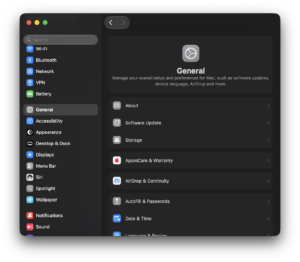
- Select General.
- Click Storage.
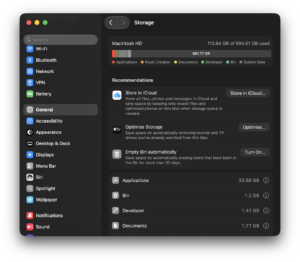
- Wait for macOS to calculate the storage categories.
You will see categories such as Applications, Documents, Photos, Messages, Mail, macOS, System Data, and Trash. Click the information button beside an available category to inspect its contents and management options.
On macOS Monterey and earlier, open Apple menu > About This Mac > Storage instead.
1. Find and Delete Large Files on Mac
Large files usually provide the fastest storage recovery. macOS can identify them without requiring another app.
- Open System Settings > General > Storage.
- Find Documents.
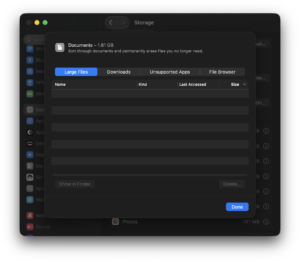
- Click its information button.
- Open Large Files if the option appears.
- Sort the results by size.
- Review files before deleting them.
Videos, virtual machines, disk images, ZIP archives, old project files, game assets, and exported media can consume tens or hundreds of gigabytes.
You can also use Finder. Open a folder, switch to List view, and sort by Size. The Downloads, Movies, Desktop, and Documents folders are good places to check first.
Search the entire Mac for large files
Finder can create a size-based search when you cannot remember where a large file is stored:
- Open Finder.
- Press Command + F.
- Select This Mac.
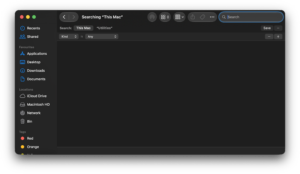
- Click the first search filter and select Other.
- Search for and select File Size.
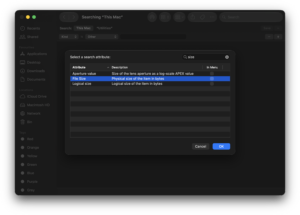
- Set the condition to is greater than.
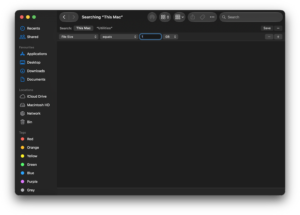
- Enter a size such as 1 GB.
Review the results rather than deleting everything Finder finds. Large files inside application or system folders can be required by macOS or installed software.
2. Clear the Downloads Folder on Mac
Downloads is one of the easiest folders to overlook because files remain there after you have opened or installed them.
- Open Finder.
- Select Downloads from the sidebar.
- Switch to List view.
- Sort by Size.
- Delete downloads you no longer need.
Look particularly for old .dmg installers, ZIP and RAR archives, videos, duplicate documents, ISO images, and application installers. Once an application has been installed correctly, you normally do not need to retain its DMG installer.
3. Empty the Trash to Actually Free the Space
Moving files to the Trash does not immediately return their disk space. The files remain on the drive until you empty it.
- Click Trash in the Dock.
- Review anything you might need to restore.
- Click Empty.
- Confirm Empty Trash.
You can have macOS automatically remove items that have remained in the Trash for more than 30 days. Open System Settings > General > Storage and enable Empty Trash Automatically if the option is available.
4. Uninstall Apps You No Longer Use
Large applications and games can recover far more space than deleting small documents individually. Check the Applications category in Storage settings because macOS can show installed apps and their approximate sizes.
- Open System Settings > General > Storage.
- Find Applications.
- Click the information button.
- Sort applications by size if available.
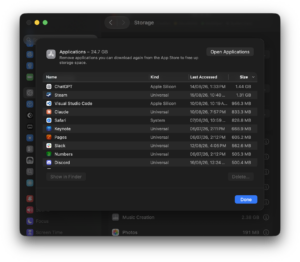
- Select an app you no longer need.
- Click Delete.
You can also open the Applications folder in Finder and move an unwanted app to the Trash. Applications installed through the App Store can also be removed from Launchpad.
For software that includes its own uninstaller, use that uninstaller. Creative suites, antivirus programs, development tools, virtual machines, and some professional applications store supporting files outside the Applications folder.
5. Use Optimize Storage on Mac
macOS includes storage recommendations that can automatically reduce local disk usage. Open System Settings > General > Storage to see the options available on your Mac.
Store in iCloud
With iCloud storage optimization enabled, macOS can keep files from Desktop and Documents in iCloud Drive and retain downloaded copies locally as needed. Photos can similarly keep full-resolution originals in iCloud while storing smaller optimized versions on the Mac.
This can save substantial local storage, but the files still consume space in your iCloud account and require sufficient iCloud capacity.
Optimize Storage
Optimize Storage can automatically remove downloaded Apple TV movies and shows after you have watched them. Mail can also avoid retaining every attachment locally when storage is needed.
Empty Trash Automatically
This option permanently removes files after they have spent more than 30 days in the Trash, preventing forgotten deleted files from continuing to occupy storage.
6. Free Up Space Used by Photos and Videos
Photo and video libraries are often among the largest items on a Mac, especially when they contain iPhone videos, RAW photos, 4K footage, or years of imported media.
Optimize Mac Storage with iCloud Photos
If you use iCloud Photos:
- Open the Photos app.
- Choose Photos > Settings.
- Open iCloud.
- Enable iCloud Photos.
- Select Optimize Mac Storage.
Full-resolution originals remain in iCloud, while macOS can replace some local originals with smaller versions when your Mac needs space.
Move your Photos library to an external drive
If you have a very large Photos library and do not want to depend on cloud storage, Apple also supports moving the library to an external storage device. Back up the library first, then move the Photos Library from your Pictures folder to a properly formatted external drive.
This approach can recover a large amount of internal SSD space while preserving the original-resolution library.
7. Delete Old iPhone and iPad Backups
Local device backups can consume significant disk space, particularly if you have backed up several iPhones or iPads over the years.
On recent versions of macOS:
- Connect the iPhone or iPad if necessary.
- Open Finder.
- Select the device in the sidebar.
- Open the General tab.
- Click Manage Backups.
- Select an obsolete backup.
- Click Delete Backup.
Check the device name and backup date before deleting anything, particularly if the backup is your only copy of data from an older device.
8. Delete Downloaded Movies, Music and Podcasts
Offline media can occupy a surprising amount of storage because downloaded content remains on the Mac until you remove it.
Check the Music, TV, and Podcasts apps for downloaded content you can stream again later. Removing a local download does not normally remove a purchase from your account.
Also check for video files outside Apple apps. Movies downloaded through a browser, video editor exports, screen recordings, and OBS recordings can be much larger than typical documents.
9. Clear Mail Downloads and Attachments
Apple Mail can accumulate local copies of messages and attachments, particularly on accounts that have been connected to the Mac for years.
Start with Mail’s built-in cleanup commands:
- Open Mail.
- Select Mailbox > Erase Junk Mail.
- Select Mailbox > Erase Deleted Items.
If Mail occupies a large amount of storage, review messages with large attachments and delete mail you no longer need. Be careful with manually deleting files from Mail’s Library folders because doing so outside the application can cause mailbox or indexing problems.
10. Move Large Files to an External SSD or Hard Drive
You do not have to delete files to recover internal disk space. Large archives, videos, Photos libraries, music libraries, completed projects, and other files you rarely need can live on an external SSD or hard drive.
Copy the files to the external drive, open several of them from the new location to confirm the copy succeeded, and only then delete the originals from your Mac.
For important data, do not treat the external drive as both storage and backup. Keep another backup of anything you cannot replace.
11. How to Clear System Data on Mac
System Data is a general storage category containing Apple and third-party files that macOS cannot classify into categories such as Applications, Photos, or Documents. It can include caches, logs, temporary files, app support data, plug-ins, archives, and other resources.
There is no single System Data folder or button that safely deletes the entire category. Its reported size can also change as macOS recalculates storage.
Restart your Mac first
A normal restart removes some temporary files and allows macOS to recalculate storage. Check System Settings > General > Storage again after restarting before manually deleting system files.
Remove applications you no longer use
Some application support files contribute to System Data. Properly uninstalling large unused applications is safer than opening Library folders and deleting unfamiliar files manually.
Check old application data
If you know an application has already been removed, you can inspect your user Library for leftover data:
- Open Finder.
- Click Go in the menu bar.
- Hold the Option key.
- Select Library.
- Check folders such as Application Support for data belonging to software you have already removed.
Delete only folders you can confidently associate with an application you no longer use. Do not mass-delete Library, cache, container, or system folders simply to reduce the System Data number.
12. Clear Cache on Mac Without Deleting Important Files
macOS automatically clears many caches and logs when storage becomes scarce, so manually deleting caches should come after removing large files and unused apps. Apple specifically notes that macOS can remove safe-to-delete caches, temporary database files, interrupted downloads, staged updates, logs, and some website data when space is required.
If one application has an unusually large cache, use that application’s own settings to clear it when possible. Browsers such as Safari, Chrome, and Firefox also provide their own controls for website data and cached content.
Avoid utilities or Terminal commands that indiscriminately erase every cache folder. Applications recreate many cache files anyway, so the storage saving can be temporary.
13. Check Time Machine Local Snapshots
Time Machine can keep local snapshots on the Mac when automatic backups are enabled. These snapshots allow you to recover previous versions of files even when the normal Time Machine backup disk is disconnected.
You usually do not need to delete them. Apple counts the space occupied by local snapshots as available storage, and macOS automatically removes snapshots as they age or when another task needs the space.
If you specifically need them removed, Apple recommends temporarily changing Time Machine’s backup frequency:
- Open System Settings > General > Time Machine.
- Click Options.
- Change Backup Frequency to Manually.
- Wait several minutes for local snapshots to be removed.
- Turn automatic backups back on afterward.
Do this only when snapshots are relevant to the storage problem. They normally manage themselves and do not prevent macOS from using the space when necessary.
14. Use Safe Mode When Your Mac Is Too Full to Update
If the startup disk is so full that you cannot install a macOS update or complete another task, starting the Mac in Safe Mode can temporarily free some space by clearing certain system caches.
Apple silicon Mac
- Shut down the Mac.
- Press and hold the power button until startup options appear.
- Select your startup volume.
- Hold Shift and click Continue in Safe Mode.
Intel Mac
- Restart or turn on the Mac.
- Immediately hold the Shift key.
- Release it when the login window appears.
- Sign in.
Restart normally after completing the task. Safe Mode is useful for temporary breathing room, but deleting or moving unnecessary files provides the lasting storage recovery.
What Should You Delete First When Your Mac Disk Is Full?
| What to check | Potential space saving | Risk |
|---|---|---|
| Large personal files | Very high | Low if reviewed first |
| Downloads | Medium to high | Low |
| Unused games and apps | High | Low |
| Old iPhone/iPad backups | High | Low if no longer needed |
| Downloaded movies and podcasts | Medium to high | Low |
| Photos and video libraries | Very high | Back up before moving or deleting |
| Trash | Varies | Files become permanently deleted |
| System Data | Varies | High if files are deleted blindly |
| Caches | Usually low to medium | Low when cleared through the relevant app |
If you need space quickly, start at the top of the table. There is little reason to spend an hour deleting cache files when an unused game, video library, or device backup can recover 20GB in a few minutes.
How Much Free Disk Space Should a Mac Have?
There is no single amount of free storage required for every Mac because the space needed depends on your applications and workload. You should still avoid running the startup disk completely full because macOS needs working space for temporary files, updates, virtual memory, application data, and other system operations.
If macOS reports that the startup disk is almost full, remove or move files rather than waiting until the available space reaches zero. Video editing, development tools, games, virtual machines, and large macOS updates need considerably more temporary working space than basic browsing and office work.
Do You Need a Mac Cleaner App?
No cleaner app is required to perform the main storage tasks in this guide. macOS already identifies storage categories and large files, removes some temporary data automatically, manages local snapshots, optimizes iCloud storage, and provides controls for uninstalling applications and deleting unnecessary content.
A third-party disk analyzer can be useful when you need a visual map of folder sizes, but check its developer, permissions, and reputation before granting it Full Disk Access. Avoid utilities that claim every cache, log, duplicate, or System Data file is safe to delete.
FAQs
What is the fastest way to free up space on a Mac?
Open System Settings > General > Storage, check Documents and Applications, and remove the largest files or unused apps first. Then clear Downloads and empty the Trash. These steps usually recover more space than clearing caches.
How do I see what is taking up the most space on my Mac?
Go to System Settings > General > Storage. macOS divides used storage into categories including Applications, Documents, Photos, Messages, Mail, System Data, and Trash.
Why is my Mac storage full when I barely have any files?
Large applications, Photos libraries, local device backups, Mail attachments, other user accounts, application support files, and System Data can consume storage even when the Desktop and Documents folders look small. Check the Storage settings rather than estimating usage from visible personal files.
How do I clear System Data on Mac?
There is no safe one-click method for deleting all System Data. Restart the Mac, uninstall unused applications, remove known leftover application data, and let macOS manage temporary caches and logs. Do not delete unfamiliar files from the System or Library folders simply to reduce the displayed System Data figure.
Can I delete cache files on Mac?
Yes, but macOS already clears many safe caches automatically when storage is needed. For browser and application caches, use the application’s own cleanup controls when available.
Why didn’t my Mac storage increase after deleting files?
Check the Trash. Files moved there continue consuming disk space until you empty it. Storage calculations can also take some time to update after a large deletion.
Does emptying Trash free disk space on Mac?
Yes. Emptying the Trash permanently deletes its contents and makes that disk space available again.
Does deleting an app free all of its storage?
Not always. Some apps store preferences, caches, projects, downloads, plug-ins, or other support data outside the application itself. Use the developer’s uninstaller when the application provides one.
Can I move files to iCloud to free Mac storage?
Yes. macOS can store Desktop and Documents files and full-resolution Photos content in iCloud while keeping optimized or recently used files locally. The content consumes storage from your iCloud plan.
Do Time Machine snapshots take up Mac storage?
They use disk capacity, but macOS counts their space as available and automatically deletes snapshots when space is needed. You normally do not need to manage them manually.
Will restarting a Mac free disk space?
A restart can remove some temporary data and correct the displayed storage calculation, but it will not substantially reduce storage occupied by applications, photos, videos, downloads, or other permanent files.
Can low disk space make a Mac slow?
Yes. Apple lists insufficient startup-disk space as one possible cause of a slow Mac. Freeing storage gives macOS more working space for system and application operations.
What can I safely delete from my Mac?
Start with personal files you no longer need, old downloads, unused applications, downloaded media, obsolete device backups, and Trash contents. Avoid manually deleting unfamiliar files from /System, /Library, or hidden macOS folders.

![What does low disk space mean? [5 ways to free disk space]](https://techdows.com/wp-content/uploads/2026/10/Windows-Update-dialog-saying-Windows-needs-more-space-to-update.jpg)