AMD's Ryzen desktop CPU list runs from the Ryzen 1000 series ("Zen", March 2017) to the Ryzen 9000 series ("Zen 5"), and the newest model is the Ryzen 9 9950X3D2 Dual Edition from April 2026.
The tables below give cores, threads, boost and base clocks, cache, TDP and availability for each desktop model, taken from AMD's own launch announcements, plus how to find which Ryzen your PC has and how to read the model number.
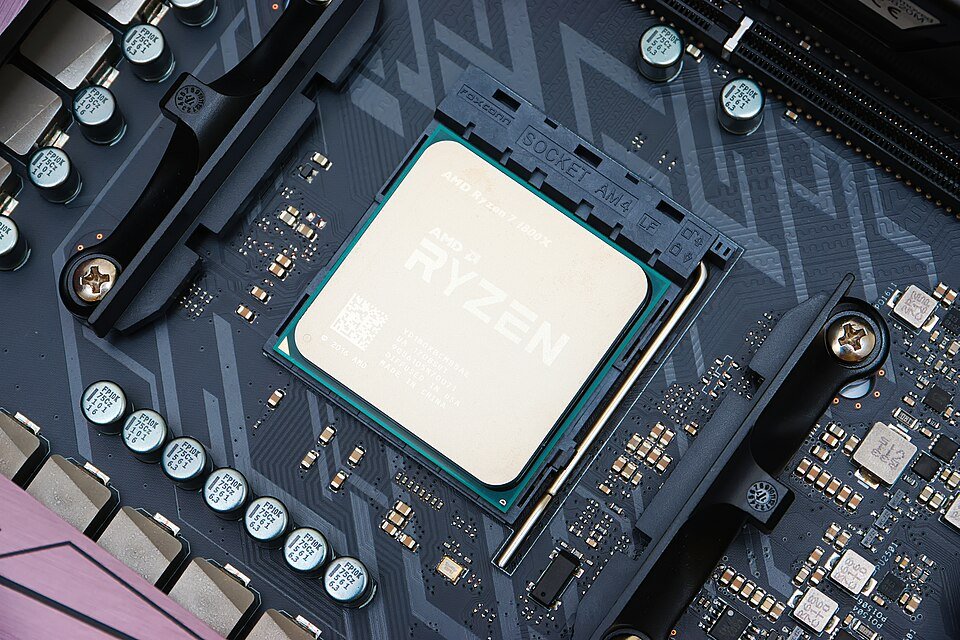
The short answer: every Ryzen desktop series in one line each
Find the first digit of your model number, then jump to that series table below. A dash in any table means AMD's announcement did not state that value.
| Model number starts with | Series | Core architecture | Socket | First desktop models available |
|---|---|---|---|---|
| 9 (for example 9700X) | Ryzen 9000 | "Zen 5" | AM5 | July 2024 |
| 8 with a G (for example 8600G) | Ryzen 8000G | — | AM5 | Announced January 8, 2024 |
| 7 (for example 7600X) | Ryzen 7000 | "Zen 4" | AM5 | September 27, 2022 |
| 5 (for example 5600X) | Ryzen 5000 | "Zen 3" | AM4 | November 5, 2020 |
| 4 (for example 4500) | Ryzen 4000 desktop | "Zen 2" | — | April 4, 2022 |
| 3 (for example 3700X) | Ryzen 3000 | "Zen 2" | AM4 | July 7, 2019 |
| 2 (for example 2600) | Ryzen 2000 | "Zen+" | AM4 | April 19, 2018 |
| 1 (for example 1700) | Ryzen 1000 | "Zen" | AM4 | March 2, 2017 |
This list covers Ryzen desktop processors sold to consumers. Laptop Ryzen chips, Ryzen PRO and Ryzen Threadripper use separate lineups and are not included.
AMD Ryzen CPU Models and Specifications
Each series is covered in its own table further down. This overview shows the range inside each series, so you can see where a model sits before you open its row.
| Series | Models listed here | Cores / threads range | Highest max boost | TDP range |
|---|---|---|---|---|
| Ryzen 9000 | 9600X to 9950X3D2 | 6/12 to 16/32 | 5.7 GHz (9950X, 9950X3D) | 65W to 200W |
| Ryzen 8000G | 8300G to 8700G | 4/8 to 8/16 | 5.1 GHz (8700G) | 65W |
| Ryzen 7000 | 7600 to 7950X3D | 6/12 to 16/32 | 5.7 GHz (7950X, 7950X3D) | 65W to 170W |
| Ryzen 5000 | 5500 to 5950X | 6/12 to 16/32 | 4.9 GHz (5950X) | 65W to 105W |
| Ryzen 4000 desktop | 4100 to 4600G | 4/8 to 6/12 | 4.2 GHz (4600G) | 65W |
| Ryzen 3000 | 3600 to 3900X | 6/12 to 12/24 | 4.6 GHz (3900X) | 65W to 105W |
| Ryzen 2000 | 2600 to 2700X | 6/12 to 8/16 | 4.3 GHz (2700X) | 65W to 105W |
| Ryzen 1000 | 1200 to 1800X | 4/4 to 8/16 | 4.0 GHz (1800X, 1600X) | 65W to 95W |
Clock speeds are the maximum boost and base figures AMD published at launch. TDP is AMD's rated thermal design power, not a measured power draw.
Which Ryzen CPUs fit an AM4 or AM5 motherboard
Your motherboard socket decides which part of this list applies to you. Match the socket first, then pick a model from that series.
| Your motherboard socket | Ryzen series AMD announced for it | What to check first |
|---|---|---|
| AM5 | Ryzen 7000, Ryzen 8000G and Ryzen 9000, including the X3D models | AMD states AM5 support runs through 2027 and beyond; check your board maker's CPU support list for the BIOS version each chip needs |
| AM4 with an X370 or B350 chipset | Ryzen 1000 at launch; Ryzen 2000 with a BIOS update | AMD says 300-series boards need a firmware (BIOS) update before a Ryzen 2000 chip will run |
| AM4 with an X470 chipset | Ryzen 2000 and all AM4 processors current in April 2018 | Newer series need your board maker's support list and BIOS |
| AM4 with an X570 chipset | Ryzen 3000, the first series with a PCIe 4.0 chipset | Check the board maker's list before fitting a Ryzen 5000 chip |
| AM4 with a 500-series chipset | Ryzen 5000 | AMD called 500-series boards ready for Ryzen 5000 at launch; check the board list for later additions such as the 5700X3D |
AMD kept adding AM4 models long after AM5 arrived. The Ryzen 7 5700X3D and Ryzen 5 5600GT reached shelves on January 31, 2024, and the 5900XT and 5800XT followed in July 2024.
The Ryzen Architecture
Every Ryzen series is built on a version of AMD's "Zen" core. The number in the model name tracks the series, and the table shows which core each series uses and what AMD changed at the platform level.
| Core | Desktop series | Platform | What AMD said changed |
|---|---|---|---|
| "Zen" | Ryzen 1000 | AM4, X370 and B350 chipsets | First Ryzen core; the Ryzen 7 lineup launched with 8 cores and 16 threads |
| "Zen+" | Ryzen 2000 | AM4, new X470 chipset | An improved "Zen" core built on a 12nm process |
| "Zen 2" | Ryzen 3000 and Ryzen 4000 desktop | AM4, X570 chipset | First Ryzen 9 desktop chip (3900X, 12 cores) and the first PCIe 4.0 chipset |
| "Zen 3" | Ryzen 5000 | AM4, 500-series chipsets | Up to 16 cores and 32 threads on AM4; later the 5800X3D added AMD 3D V-Cache |
| "Zen 4" | Ryzen 7000 | AM5 | TSMC 5nm process, dual-channel DDR5 memory and up to 24 PCIe 5.0 lanes |
| "Zen 5" | Ryzen 9000 | AM5 | PCIe 5.0 and DDR5 support; X3D models use second-generation 3D V-Cache, and the 9950X3D2 uses two |
The first digit does not always match the core. The Ryzen 4000 desktop models (4100, 4500, 4600G) use "Zen 2", the same core as the Ryzen 3000 series.
Ryzen 9000 Series (Zen 5)
AMD built the Ryzen 9000 series on "Zen 5" for the Socket AM5 motherboard family. The first four models went on sale in July 2024, and X3D models followed through 2026.
| Model | Cores / threads | Max boost / base | Total cache | TDP | Availability per AMD |
|---|---|---|---|---|---|
| Ryzen 9 9950X3D2 Dual Edition | 16 / 32 | 5.6 / 4.3 GHz | 208 MB | 200W | April 22, 2026 |
| Ryzen 9 9950X3D | 16 / 32 | 5.7 / 4.3 GHz | 144 MB | 170W | Q1 2025 |
| Ryzen 9 9950X | 16 / 32 | 5.7 / 4.3 GHz | 80 MB | 170W | July 2024 |
| Ryzen 9 9900X3D | 12 / 24 | 5.5 / 4.4 GHz | 140 MB | 120W | Q1 2025 |
| Ryzen 9 9900X | 12 / 24 | 5.6 / 4.4 GHz | 76 MB | 120W | July 2024 |
| Ryzen 7 9850X3D | 8 / 16 | 5.6 / 4.7 GHz | 104 MB | 120W | Q1 2026 |
| Ryzen 7 9800X3D | 8 / 16 | 5.2 / 4.7 GHz | 104 MB | 120W | Announced October 31, 2024 |
| Ryzen 7 9700X | 8 / 16 | 5.5 / 3.8 GHz | 40 MB | 65W | July 2024 |
| Ryzen 5 9600X | 6 / 12 | 5.4 / 3.9 GHz | 38 MB | 65W | July 2024 |
AMD describes the 9950X3D2 Dual Edition as the first processor to bring dual AMD 3D V-Cache technology to the desktop. That is why its total cache reaches 208 MB.
Ryzen 8000G Series (AM5 with Radeon graphics)
AMD introduced the Ryzen 8000G series for the AM5 platform on January 8, 2024. Two models also carry a neural processing unit (NPU).
| Model | Cores / threads | Max boost / base | Total cache | TDP | NPU |
|---|---|---|---|---|---|
| Ryzen 7 8700G | 8 / 16 | 5.1 / 4.2 GHz | 24 MB | 65W | Yes |
| Ryzen 5 8600G | 6 / 12 | 5.0 / 4.3 GHz | 22 MB | 65W | Yes |
| Ryzen 5 8500G | 6 / 12 | 5.0 / 3.5 GHz | 22 MB | 65W | Not listed |
| Ryzen 3 8300G | 4 / 8 | 4.9 / 3.4 GHz | 12 MB | 65W | Not listed |
Ryzen 7000 Series (Zen 4)
The Ryzen 7000 series was the first on Socket AM5. AMD released it in three waves: X models in September 2022, 65W non-X models in January 2023 and X3D models in February 2023.
| Model | Cores / threads | Max boost / base | Total cache | TDP | Availability per AMD |
|---|---|---|---|---|---|
| Ryzen 9 7950X3D | 16 / 32 | 5.7 / 4.2 GHz | 144 MB | 120W | February 2023 |
| Ryzen 9 7950X | 16 / 32 | 5.7 / 4.5 GHz | 80 MB | 170W | September 27, 2022 |
| Ryzen 9 7900X3D | 12 / 24 | 5.6 / 4.4 GHz | 140 MB | 120W | February 2023 |
| Ryzen 9 7900X | 12 / 24 | 5.6 / 4.7 GHz | 76 MB | 170W | September 27, 2022 |
| Ryzen 9 7900 | 12 / 24 | 5.4 / 3.7 GHz | 76 MB | 65W | January 10, 2023 |
| Ryzen 7 7800X3D | 8 / 16 | 5.0 GHz / — | 104 MB | 120W | February 2023 |
| Ryzen 7 7700X | 8 / 16 | 5.4 / 4.5 GHz | 40 MB | 105W | September 27, 2022 |
| Ryzen 7 7700 | 8 / 16 | 5.3 / 3.8 GHz | 40 MB | 65W | January 10, 2023 |
| Ryzen 5 7600X | 6 / 12 | 5.3 / 4.7 GHz | 38 MB | 105W | September 27, 2022 |
| Ryzen 5 7600 | 6 / 12 | 5.1 / 3.8 GHz | 38 MB | 65W | January 10, 2023 |
AMD listed the 7800X3D base clock as TBD at announcement, so the cell is left blank here.
Ryzen 5000 Series (Zen 3)
The Ryzen 5000 series launched on "Zen 3" in November 2020 and is the longest-running AM4 lineup. AMD added models in 2022, January 2024 and July 2024.
| Model | Cores / threads | Max boost / base | Total cache | TDP | Availability per AMD |
|---|---|---|---|---|---|
| Ryzen 9 5950X | 16 / 32 | 4.9 / 3.4 GHz | 72 MB | 105W | November 5, 2020 |
| Ryzen 9 5900XT | 16 / 32 | 4.8 / 3.3 GHz | 72 MB | 105W | July 2024 |
| Ryzen 9 5900X | 12 / 24 | 4.8 / 3.7 GHz | 70 MB | 105W | November 5, 2020 |
| Ryzen 7 5800X | 8 / 16 | 4.7 / 3.8 GHz | 36 MB | 105W | November 5, 2020 |
| Ryzen 7 5800XT | 8 / 16 | 4.8 / 3.8 GHz | 36 MB | 105W | July 2024 |
| Ryzen 7 5800X3D | 8 cores / — | — | — | — | April 20, 2022 |
| Ryzen 7 5700X3D | 8 / 16 | 4.1 / 3.0 GHz | 100 MB | 105W | January 31, 2024 |
| Ryzen 7 5700X | 8 / 16 | 4.6 / 3.4 GHz | 36 MB | 65W | Announced March 15, 2022 |
| Ryzen 7 5700 | 8 / 16 | 4.6 / 3.7 GHz | 20 MB | 65W | January 31, 2024 |
| Ryzen 5 5600X | 6 / 12 | 4.6 / 3.7 GHz | 35 MB | 65W | November 5, 2020 |
| Ryzen 5 5600 | 6 / 12 | 4.4 / 3.5 GHz | 35 MB | 65W | April 4, 2022 |
| Ryzen 5 5600GT | 6 / 12 | 4.6 / 3.6 GHz | 19 MB | 65W | January 31, 2024 |
| Ryzen 5 5500 | 6 / 12 | 4.2 / 3.6 GHz | 19 MB | 65W | April 4, 2022 |
| Ryzen 5 5500GT | 6 / 12 | 4.4 / 3.6 GHz | 19 MB | 65W | January 31, 2024 |
AMD's releases name the core only for the original four models and for the 5700X, 5600 and 5500, all "Zen 3". The 5800X3D row stays short because AMD's announcements that could be read gave only its core count.
Ryzen 4000 Desktop Models (Zen 2)
AMD added three budget desktop chips on the older "Zen 2" core in April 2022. Each one shipped with a Wraith Stealth cooler.
| Model | Cores / threads | Max boost / base | Total cache | TDP | Availability per AMD |
|---|---|---|---|---|---|
| Ryzen 5 4600G (with AMD Radeon graphics) | 6 / 12 | 4.2 / 3.7 GHz | 11 MB | 65W | April 4, 2022 |
| Ryzen 5 4500 | 6 / 12 | 4.1 / 3.6 GHz | 11 MB | 65W | April 4, 2022 |
| Ryzen 3 4100 | 4 / 8 | 4.0 / 3.8 GHz | 6 MB | 65W | April 4, 2022 |
Ryzen 3000 Series (Third Generation, Zen 2)
AMD called these the 3rd Gen Ryzen desktop processors. All five launched together on July 7, 2019, and the 3900X was the first Ryzen 9.
| Model | Cores / threads | Max boost / base | Total cache | TDP | Availability per AMD |
|---|---|---|---|---|---|
| Ryzen 9 3900X | 12 / 24 | 4.6 / 3.8 GHz | 70 MB | 105W | July 7, 2019 |
| Ryzen 7 3800X | 8 / 16 | 4.5 / 3.9 GHz | 36 MB | 105W | July 7, 2019 |
| Ryzen 7 3700X | 8 / 16 | 4.4 / 3.6 GHz | 36 MB | 65W | July 7, 2019 |
| Ryzen 5 3600X | 6 / 12 | 4.4 / 3.8 GHz | 35 MB | 95W | July 7, 2019 |
| Ryzen 5 3600 | 6 / 12 | 4.2 / 3.6 GHz | 35 MB | 65W | July 7, 2019 |
Ryzen 2000 Series (Second Generation, Zen+)
The 2nd Gen Ryzen desktop chips moved to the "Zen+" core on a 12nm process. All four went on sale worldwide on April 19, 2018.
| Model | Cores / threads | Max boost / base | Total cache | TDP | Availability per AMD |
|---|---|---|---|---|---|
| Ryzen 7 2700X | 8 / 16 | 4.3 / 3.7 GHz | 20 MB | 105W | April 19, 2018 |
| Ryzen 7 2700 | 8 / 16 | 4.1 / 3.2 GHz | 20 MB | 65W | April 19, 2018 |
| Ryzen 5 2600X | 6 / 12 | 4.2 / 3.6 GHz | 19 MB | 95W | April 19, 2018 |
| Ryzen 5 2600 | 6 / 12 | 3.9 / 3.4 GHz | 19 MB | 65W | April 19, 2018 |
Ryzen 1000 Series (First Generation, Zen)
The first Ryzen chips arrived in three waves in 2017: Ryzen 7 in March, Ryzen 5 in April and Ryzen 3 in July. AMD's tables for this series did not list cache.
| Model | Cores / threads | Max boost / base | TDP | Availability per AMD |
|---|---|---|---|---|
| Ryzen 7 1800X | 8 / 16 | 4.0 / 3.6 GHz | 95W | March 2, 2017 |
| Ryzen 7 1700X | 8 / 16 | 3.8 / 3.4 GHz | 95W | March 2, 2017 |
| Ryzen 7 1700 | 8 / 16 | 3.7 / 3.0 GHz | 65W | March 2, 2017 |
| Ryzen 5 1600X | 6 / 12 | 4.0 / 3.6 GHz | 95W | April 11, 2017 |
| Ryzen 5 1600 | 6 / 12 | 3.6 / 3.2 GHz | 65W | April 11, 2017 |
| Ryzen 5 1500X | 4 / 8 | 3.7 / 3.5 GHz | 65W | April 11, 2017 |
| Ryzen 5 1400 | 4 / 8 | 3.4 / 3.2 GHz | 65W | April 11, 2017 |
| Ryzen 3 1300X | 4 / 4 | 3.7 / 3.5 GHz | 65W | July 27, 2017 |
| Ryzen 3 1200 | 4 / 4 | 3.4 / 3.1 GHz | 65W | July 27, 2017 |
How to read a Ryzen desktop model number
Take the Ryzen 7 9800X3D as the example. Each part of the name tells you something you can check against AMD's own spec tables above.
| Part of the name | Example | What it tells you, based on AMD's tables |
|---|---|---|
| Ryzen 3, 5, 7 or 9 | Ryzen 7 | The tier. Every Ryzen 9 above has 12 or 16 cores, every Ryzen 7 has 8, most Ryzen 5 chips have 6, and Ryzen 3 has 4 |
| First digit | 9800X3D | The series: 9 is Ryzen 9000. It is not always the core generation, because the 4000 desktop chips use "Zen 2" |
| Remaining digits | 9800X3D | The position inside the series. Within one series, a higher number never has fewer cores in these tables |
| X suffix | 7600X vs 7600 | In the 1000, 2000, 3000 and 7000 pairs, the X model has a higher boost clock and a higher TDP. The 5700X and 5700 share a 4.6 GHz boost and 65W, but the 5700X has 36 MB of cache against 20 MB |
| X3D suffix | 9800X3D | AMD 3D V-Cache technology, which is why the cache jumps from 40 MB (9700X) to 104 MB |
| X3D2 | 9950X3D2 | Dual AMD 3D V-Cache, 208 MB in total |
| G suffix | 4600G, 8700G | AMD lists the 4600G "with AMD Radeon graphics"; in the 8000G series, the 8700G and 8600G also list an NPU |
Ryzen laptop chips follow a different naming scheme, so a laptop model number cannot be decoded with this table.
How to check which Ryzen CPU is in your PC
Windows shows the exact processor name in Settings. Use it to find your row in the tables above.
- Right-click Start and choose Settings.
- Select System.
- Select About.
- Under Device specifications, read the processor name, for example AMD Ryzen 7 followed by the four-digit model number.
- Match the model number to its series using the first digit, then find the row in that series table.
The same section lists the installed RAM and whether Windows is 32-bit or 64-bit.
How to confirm your cores and threads in Task Manager
Task Manager shows the core count Windows sees. If it matches the table row, you have the right model.
- Press Ctrl + Shift + Esc, or right-click Start and select Task Manager.
- Select the Performance tab.
- Select CPU.
- Read the numbers next to Cores and Logical processors.
- Compare them with the cores / threads column for your model. Logical processors equals threads, so a Ryzen 7 9700X shows 8 cores and 16 logical processors.
If the numbers differ from the row, re-read the processor name in Settings > System > About. Models such as the 7600 and 7600X share a core count, so the suffix matters.
Frequently Asked Questions
What is the newest AMD Ryzen desktop CPU?
The newest model in AMD's announcements is the Ryzen 9 9950X3D2 Dual Edition, available from April 22, 2026. It has 16 cores, 32 threads, a 5.6 GHz max boost, 208 MB of total cache and a 200W TDP, and uses the "Zen 5" core.
Which Ryzen CPUs use socket AM4?
The Ryzen 1000, 2000, 3000 and 5000 desktop series use socket AM4. That includes later AM4 additions such as the 5800X3D, 5700X3D, 5600GT, 5500GT, 5900XT and 5800XT. Older AM4 boards can need a BIOS update, so check your board maker's CPU support list.
Which Ryzen CPUs use socket AM5?
The Ryzen 7000, Ryzen 8000G and Ryzen 9000 series use socket AM5, including all of their X3D models. AMD states AM5 platform support runs through 2027 and beyond, and the Ryzen 7000 launch introduced dual-channel DDR5 on the platform.
What Ryzen 9 CPUs are there?
The Ryzen 9 desktop models are the 3900X, 5900X, 5950X, 5900XT, 7900, 7900X, 7900X3D, 7950X, 7950X3D, 9900X, 9900X3D, 9950X, 9950X3D and 9950X3D2. Every one has 12 or 16 cores, from the 12-core 3900X in 2019 to the 16-core 9950X3D2 in 2026.
What Ryzen 7 CPUs are there?
The Ryzen 7 desktop models are the 1700, 1700X, 1800X, 2700, 2700X, 3700X, 3800X, 5700, 5700X, 5700X3D, 5800X, 5800X3D, 5800XT, 7700, 7700X, 7800X3D, 8700G, 9700X, 9800X3D and 9850X3D. All of them have 8 cores.
What Ryzen 5 CPUs are there?
The Ryzen 5 desktop models are the 1400, 1500X, 1600, 1600X, 2600, 2600X, 3600, 3600X, 4500, 4600G, 5500, 5500GT, 5600, 5600GT, 5600X, 7600, 7600X, 8500G, 8600G and 9600X. Most have 6 cores and 12 threads; the 1400 and 1500X have 4 cores and 8 threads.
Is there an official AMD Ryzen CPU list ranked by performance?
No. AMD publishes specifications, not a best-to-worst ranking across series. Use the tables to compare cores, threads, max boost clock, cache and TDP for the models you are choosing between.
What does X3D mean on a Ryzen CPU?
X3D means the chip uses AMD 3D V-Cache technology, which adds a large block of extra cache. It shows in the specs: the Ryzen 7 9800X3D has 104 MB of total cache, while the Ryzen 7 9700X has 40 MB.
How do I find out which Ryzen CPU I have?
Right-click Start, choose Settings, then select System > About. The Processor line under Device specifications shows the full model name. Match its first digit to the series table in this list.



Windows 11 26H2 supported CPU list - Techdows
[…] Ryzen 1000 and 2000 desktop series do not appear on the 25H2 AMD list. For model-level specs, see the AMD Ryzen CPU list. […]
AMD vs Intel processors comparison chart - Techdows
[…] Ryzen 7000 and Ryzen 5000 chips use different sockets and memory, so check the full AMD Ryzen CPU list before you mix […]