Abbreviate example as e.g. when it replaces the phrase for example, and as ex. when it labels a specific example such as Ex. 1.
This page covers every accepted short form, the punctuation each one takes, what the Microsoft and Google style guides rule, plurals, and the e.g. versus i.e. mix-up.
The fastest way to abbreviate example
e.g. comes from the Latin exempli gratia, which means "for example". It introduces an instance, never an explanation.
- Decide which job the short form does: introducing an instance inside a sentence, or labelling one.
- To introduce an instance, write e.g. in lowercase with a period after each letter, then a comma before the instance.
- To label a numbered instance in a caption, figure or worksheet, write Ex. followed by the number, as in Ex. 3.
- Keep the full phrase for example in ordinary body text and in anything written for a wide or international audience.
- Check that you did not want i.e. instead. e.g. introduces an example; i.e. introduces an explanation.
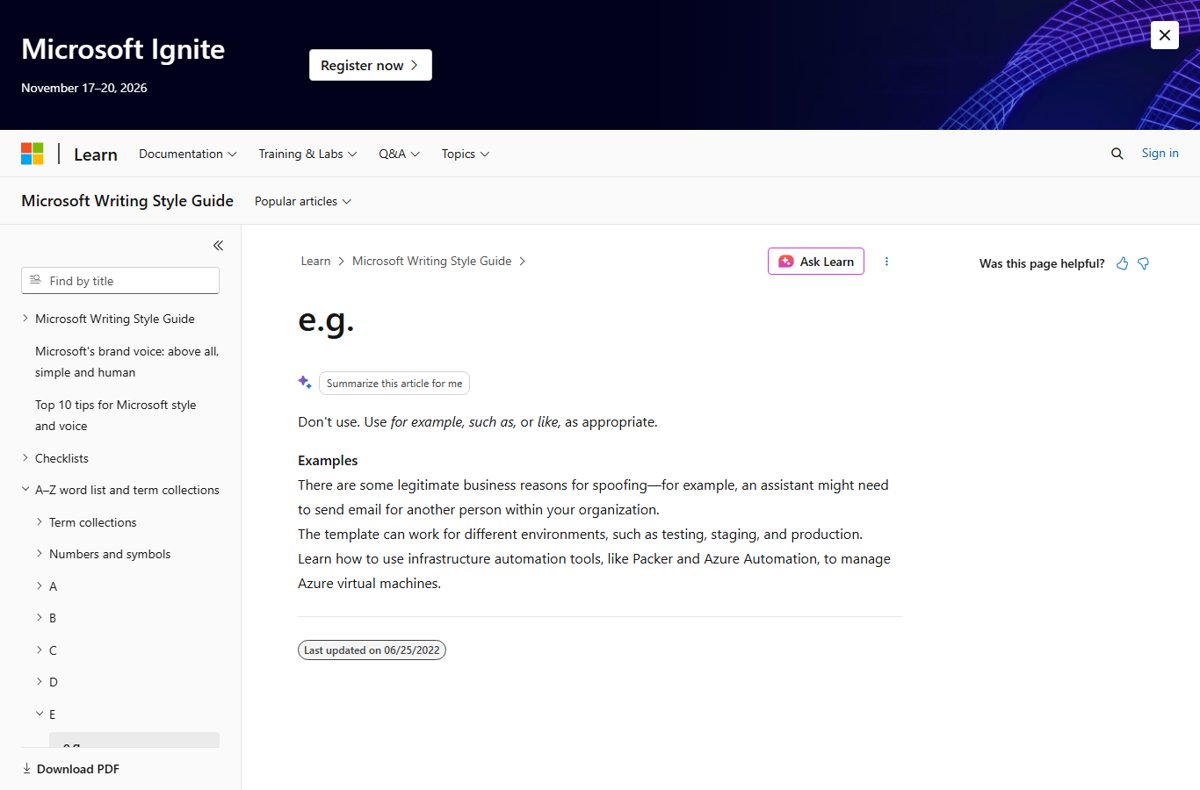
Both the Microsoft Writing Style Guide and the Google developer documentation style guide tell writers to use for example rather than e.g.
Common Abbreviations of "Example"
Five short forms circulate in English writing. Only two of them survive scrutiny in published work.
| Short form | What it stands for | Where it belongs | What goes wrong |
|---|---|---|---|
| e.g. | Latin exempli gratia, "for example" | Inside parentheses, tables and tight spaces | Dropping a period, or capitalising it mid-sentence |
| E.g. | The same abbreviation, capitalised | Only as the first word of a sentence | A capital in the middle of a sentence reads as a typo |
| Eg. | A hybrid spelling with one period | No major style guide lists it | The Latin is two words, so standard American usage keeps both periods; AMA style drops both and writes eg |
| ex. | A shortened form of the English word example | Labels, captions, worksheets and margin notes | Neither the Microsoft nor the Google style guide word list includes it, so it is not safe in formal copy |
| for example | Nothing; it is the full phrase | Body text, documentation, email, translated copy | Forgetting the comma that follows it |
| i.e. | Latin id est, "that is" | Introducing an explanation, not an example | Used where e.g. was meant, which reverses the sentence |
When and How to Use Abbreviations of "Example"
The right short form depends on who reads the sentence and how much room it has.
| Your situation | Use this | Why |
|---|---|---|
| A formal report, thesis or published article | for example | Microsoft and Google both rule against e.g. in running text |
| Academic or technical writing under a house style | Whatever that house style lists | AMA style writes eg with no periods; general American usage writes e.g. |
| A parenthesis or a narrow table cell | e.g. | The full phrase will not fit, and the parenthesis already signals an aside |
| Your own note-taking and study material | ex. or e.g. | Only you read it, so speed matters more than consistency |
| Digital messages and text messaging | e.g. or the full phrase | Both are readable; internet slang forms such as tl;dr are not, and Google's guide bans them |
| An email to a wide or international audience | for example | Google's guide notes that spelling a term out gives context for human and machine translation |
| A figure caption or numbered exercise | Ex. 1, Ex. 2 | A short label fits where the full word would crowd the caption |
The Significance of Abbreviating "Example"
Shortening the word changes more than the character count. Each style guide names a specific cost.
| What the abbreviation changes | What the style guide says | Practical effect |
|---|---|---|
| Reading speed | Google: abbreviations are intended to save the writer and the reader time | A familiar form speeds reading; an unfamiliar one slows comprehension |
| Clarity and voice | Microsoft: acronyms and abbreviations can have an adverse effect on clarity, voice and findability | The spelled-out phrase keeps the sentence conversational |
| Translation | Google: spelling a term out provides context for both human and machine translation | e.g. can be carried across untranslated or dropped |
| Findability | Microsoft lists findability alongside clarity and voice | for example is the searchable string; e.g. is not |
| Precision | Google: many people confuse e.g. and i.e. | One wrong letter turns an example into a definition |
Style Guide Recommendations
Two of the largest technical publishers put their rulings online. The rest are summarised in reference works.
| Style guide | Ruling that applies to abbreviating example | Where it is written |
|---|---|---|
| Microsoft Writing Style Guide | Do not use e.g. Use for example, such as, or like, as appropriate. | A-Z word list: e.g. |
| Google developer documentation style guide | Do not use e.g. or i.e.; use for example and that is. Follow for example with a comma. | Abbreviations |
| Google, on shortened words | Put a period at the end of a shortened word, and no period on an acronym or initialism. | Abbreviations |
| Microsoft, on plurals | Add a lowercase s to make an abbreviation plural, exactly as with any other noun. | Acronyms |
| MLA | Do not use an apostrophe to form the plural of an abbreviation. | Abbreviation (Wikipedia) |
| APA | Plural abbreviations take an s without an apostrophe. | Abbreviation (Wikipedia) |
| AMA style | Uses no periods in abbreviations, so it writes eg, ie and et al. | Abbreviation (Wikipedia) |
| Hart's Rules | A word shortened by dropping letters from the end takes a full stop, so ex. keeps its period. | Abbreviation (Wikipedia) |
| The Guardian and The Economist | Disallow periods in all abbreviations. | Abbreviation (Wikipedia) |
| Chicago Manual of Style | Not published on an open page; read the manual itself rather than a second-hand summary. | Subscription only |
Where two guides disagree, the one your publisher uses wins. Pick it once and apply it to every abbreviation in the document.
Creating Custom Abbreviations for "Example"
A document with numbered exercises, figures or test cases often needs its own short label. These steps keep a custom form defensible.
- Count how often the word appears. Google's rule is that a term used only once should be spelled out rather than abbreviated.
- Spell the term out on first use and put the short form in parentheses immediately after it, as in example (ex.).
- Number or letter the examples instead of repeating the word: Ex. 1, Ex. 2, or Example A.
- Put a period at the end of ex. because it is a shortened word, not an initialism. Writing ex without punctuation breaks Google's rule.
- Keep symbols out of running text. Google's guide says to spell out common symbols that substitute for words.
- Use one form everywhere, then collect every custom abbreviation in a list at the front or back of the document, which is the long-standing convention for author-specific abbreviations.
- Lowercase the spelled-out term unless it is a proper noun, following Microsoft's rule for introducing a short form.
Special Considerations
Four details catch out writers who have already chosen a short form.
| Consideration | Rule | Worked instance |
|---|---|---|
| Plural forms | Add a lowercase s and no apostrophe. Microsoft sets the s; MLA and APA both forbid the apostrophe. | exs. is unlisted, so write examples in full |
| Combining abbreviations | When an abbreviation ends a sentence, one period serves both the abbreviation and the sentence. | The capital of the United States is Washington, D.C. |
| Avoiding confusion | e.g. introduces an instance; i.e. introduces an explanation. | Heavy items, e.g. a car — heavy items, i.e. anything over a ton |
| Capitalisation | Capitalise only where the abbreviation opens a sentence. | E.g. a car. / … a surcharge, e.g. a car. |
| Headings and captions | Microsoft style keeps periods out of headings, subheadings and short list items. | A heading reads better with the phrase spelled out |
How to check the abbreviation reads correctly
Two substitutions catch almost every misuse of e.g. before anyone else sees the sentence.
- Read the sentence aloud with for example in place of e.g. The sentence should still make sense.
- Now read it with that is instead. If that version is the one you meant, change the abbreviation to i.e.
- Confirm both periods are present in e.g. and that the letters are lowercase anywhere other than the start of a sentence.
- Confirm a comma follows the abbreviation wherever the full phrase would take one.
- Search the document for each form and confirm only one of them is in use.
- Check headings and figure captions separately, because Microsoft style strips periods from headings and short list items.
Fix an abbreviated example that reads wrong
e.g. and i.e. keep getting swapped
Both are Latin, and only the expansion separates them.
- Expand the abbreviation in your head: e.g. is exempli gratia, "for example"; i.e. is id est, "that is".
- Use the e in e.g. as the mnemonic for example given, and the i in i.e. for in other words.
- If the words after the abbreviation are a complete list, the sentence wanted i.e. If they are a sample of a longer list, it wanted e.g.
- Replace both with for example and that is if the document is aimed at a general audience.
The abbreviation in parentheses makes the sentence hard to follow
Google's guide notes that some readers skip anything inside parentheses.
- Move the instance out of the parentheses and set it off with an em dash instead: enter a name — for example, my-instance-99.
- Keep any parenthetical thought short if it has to stay mid-sentence.
- Split the sentence in two when the parenthesis grows past a few words.
- Put the period inside the parentheses only when a full standalone sentence sits inside them.
The abbreviation looks too casual in an email
A Latin abbreviation compresses the sentence but also flattens its tone.
- Replace e.g. with for example, such as, or like, which is the wording Microsoft recommends.
- Follow for example with a comma, as Google's word list requires.
- Drop ex. entirely in email, since neither style guide lists it.
- Leave internet slang abbreviations out; Google's guide names tl;dr and ymmv as forms to write out in full.
The text loses its meaning after translation
Machine translation has no reliable expansion for a Latin abbreviation.
- Spell the term out, which Google says gives context to both human and machine translators.
- Watch abbreviations that form common English words, a case Microsoft flags as a machine-translation risk.
- Keep the spelled-out term outside the parentheses rather than inside them.
- Run a final pass for any remaining e.g., i.e. and etc. before the file goes to a translator.
Frequently Asked Questions
How is example abbreviated?
Example is abbreviated as e.g. when it stands in for the phrase "for example", and as ex. when it labels a specific instance such as Ex. 1. e.g. comes from the Latin exempli gratia.
How do you abbreviate example in a sentence?
Write e.g. in lowercase with a period after each letter, then a comma, then the instance. Set the whole aside off with commas, dashes or parentheses. Google's word list requires the comma after "for example" and its abbreviation.
How do you abbreviate example in parentheses?
Write it as (for example, 228B22) or (e.g., 228B22). Google's guide recommends the spelled-out form and warns that some readers skip parentheses entirely, so keep the parenthetical short or use an em dash instead.
How do you abbreviate example in an email?
Use for example rather than e.g. in email. The Microsoft Writing Style Guide tells writers to replace e.g. with for example, such as, or like, and the full phrase survives translation and forwarding intact.
How do you abbreviate example in Spanish?
Spanish abbreviates por ejemplo as p. ej., and also as ej., v. g. or v. gr. from the Latin verbi gratia. Spanish abbreviations end in a period under Real Academia Española rules.
How do you abbreviate for example in English?
e.g. is the standard abbreviation for "for example" in English. It is lowercase with two periods. Both the Microsoft and Google style guides prefer the unabbreviated phrase in body text and reserve e.g. for cramped space.
What is the correct way to abbreviate example?
For the phrase "for example", the correct form is e.g. with both periods and no capital mid-sentence. For a labelled instance, ex. with a trailing period. Eg. and ex without punctuation are not standard.
How do you write examples in abbreviation?
Add a lowercase s and no apostrophe, which is Microsoft's rule for abbreviation plurals and matches both MLA and APA. Because exs. appears in no major word list, write examples in full instead.
Can you abbreviate example as Eg.?
No. Eg. mixes two conventions. Standard American usage keeps a period after each letter of e.g., while AMA style drops both and writes eg. No listed style guide uses a single trailing period.
Is E.g. capitalized?
Only at the start of a sentence. Anywhere else, e.g. stays lowercase. A capital mid-sentence reads as a typo, and Microsoft's rule is to lowercase the spelled-out form of an abbreviation unless it is a proper noun.
How do you abbreviate definition?
No entry for a definition abbreviation appears in either the Microsoft or the Google style guide word list, so spell the word out. Google's rule is to use the most common form of a word when the spelled-out version is easily understood.
How can I abbreviate a word safely?
Spell the term out on first use and put the short form in parentheses immediately after. Skip the abbreviation if the term appears only once. Put a period after a shortened word and none after an initialism.
Best Practices for Abbreviating "Example"
Spell the phrase out in body text. Reserve e.g. for parentheses, tables and captions where the full phrase will not fit.
Keep both periods, keep the letters lowercase mid-sentence, follow the abbreviation with a comma, and pluralise with a bare s.
Write for example in running text and keep e.g. for tight spaces. Microsoft and Google both rule against e.g. in body copy, and the spelled-out phrase carries the same meaning to every reader, every translator and every search engine.