Nvidia's GeForce GTX desktop cards run from the GTX 260 through the GTX 1660 Ti across eight series: GTX 200, 400, 500, 600, 700, 900, 10 and 16, with the GTX 16 Series (Turing) as the newest and the only GTX line still listed with Game Ready drivers.
Below is every desktop GTX model by series with its architecture, the published specs Nvidia still lists, and what each card can and cannot run today.
Every Nvidia GTX desktop card at a glance
| Series | Desktop GTX models | Architecture |
|---|---|---|
| GTX 16 | GTX 1630, 1650 (G5), 1650 (G6), 1650 Super, 1660, 1660 Super, 1660 Ti | Turing |
| GTX 10 | GTX 1050, 1050 Ti, 1060 3GB, 1060 5GB, 1060 6GB, 1070, 1070 Ti, 1080, 1080 Ti | Pascal |
| GTX 900 | GTX 950, 960, 970, 980, 980 Ti, GTX TITAN X | Maxwell |
| GTX 700 | GTX 745, 750, 750 Ti, 760, 760 (192-bit), 760 Ti OEM, 770, 780, 780 Ti, GTX TITAN, TITAN Black, TITAN Z | Kepler (750 and 750 Ti are Maxwell) |
| GTX 600 | GTX 645, 650, 650 Ti, 650 Ti BOOST, 660, 660 Ti, 670, 680, 690 | Kepler |
| GTX 500 | GTX 550 Ti, 555, 560, 560 SE, 560 Ti, 570, 580, 590 | Fermi |
| GTX 400 | GTX 460, 460 SE, 460 v2, 460 SE v2, 465, 470, 480 | Fermi |
| GTX 200 | GTX 260, 275, 280, 285, 295 | Tesla |
Nvidia's driver lists show GTX 800 names only as laptop chips (GTX 850M, 860M, 870M, 880M), so there is no desktop GTX 800 card to look for.
Introduction to Nvidia GTX Graphics Cards
GTX is the gaming tier of Nvidia's GeForce brand. The number after GTX tells you the series and the card's place in it: in a GTX 1660 Ti, "16" is the series and "60" the tier, and a higher tier means a faster card within that series.
| Name part | Meaning | Example |
|---|---|---|
| Leading digits | Series (generation) | GTX 970, GTX 1080 |
| Last two digits | Tier within the series; 50 is entry, 80 is high end | GTX 1050 vs GTX 1080 |
| Ti | Faster version of the same tier | GTX 1080 Ti |
| Super | Refreshed, faster version (16 Series) | GTX 1660 Super |
| M or Max-Q | Laptop chip | GTX 970M, GTX 1070 with Max-Q Design |
| TITAN | Top card above the 80 tier | GTX TITAN X |
The Evolution of the GTX Series
Each new series moved to a new GPU architecture. Nvidia's CUDA compute capability number tracks the same steps: 1 for Tesla, 2 for Fermi, 3 for Kepler, 5 for Maxwell, 6 for Pascal and 7.5 for Turing.
| Series | Architecture | CUDA compute capability | Linux driver branch |
|---|---|---|---|
| GTX 200 | Tesla | 1.3 | 340.xx legacy |
| GTX 400 / 500 | Fermi | 2.0 / 2.1 | 390.xx legacy |
| GTX 600 / 700 | Kepler | 3.0 / 3.5 | 470.xx legacy |
| GTX 750 / 750 Ti | Maxwell (first generation) | 5.0 | 580.xx legacy |
| GTX 900 | Maxwell | 5.2 | 580.xx legacy |
| GTX 10 | Pascal | 6.1 | 580.xx legacy |
| GTX 16 | Turing | 7.5 | Current driver |
GTX 200 Series
| Model | CUDA compute capability |
|---|---|
| GTX 295 | 1.3 |
| GTX 285 (also GTX 285 for Mac) | 1.3 |
| GTX 280 | 1.3 |
| GTX 275 | 1.3 |
| GTX 260 | 1.3 |
All GTX 200 cards use the Tesla architecture (compute capability 1.3). On Linux they are limited to the 340.xx legacy driver.
GTX 400 Series
| Model | CUDA compute capability |
|---|---|
| GTX 480 | 2.0 |
| GTX 470 | 2.0 |
| GTX 465 | 2.0 |
| GTX 460, 460 SE, 460 v2, 460 SE v2 | 2.1 (GTX 460) |
The GTX 400 Series was the first GTX line on the Fermi architecture. Linux support ends with the 390.xx legacy driver.
GTX 500 Series
| Model | CUDA compute capability |
|---|---|
| GTX 590 | 2.0 |
| GTX 580 | 2.0 |
| GTX 570 | 2.0 |
| GTX 560 Ti | 2.1 |
| GTX 560, 560 SE, 555 | Fermi, 390.xx driver branch |
| GTX 550 Ti | 2.1 |
The GTX 500 Series stays on Fermi (compute capability 2.0 and 2.1). Linux support ends with the 390.xx legacy driver, the same branch as the GTX 400 Series.
GTX 600 Series
| Model | CUDA compute capability |
|---|---|
| GTX 690 | 3.0 |
| GTX 680 | 3.0 |
| GTX 670 | 3.0 |
| GTX 660 Ti | 3.0 |
| GTX 660 | 3.0 |
| GTX 650 Ti BOOST, 650 Ti, 650 | 3.0 |
| GTX 645 | Kepler, 470.xx driver branch |
The GTX 600 Series introduced the Kepler architecture. Linux support ends with the 470.xx legacy driver.
GTX 700 Series
| Model | Architecture | CUDA compute capability |
|---|---|---|
| GTX TITAN Z, TITAN Black, TITAN | Kepler | 3.5 |
| GTX 780 Ti, 780 | Kepler | 3.5 |
| GTX 770, 760 | Kepler | 3.0 |
| GTX 760 (192-bit), 760 Ti OEM | Kepler | 470.xx driver branch |
| GTX 750 Ti, 750 | Maxwell | 5.0 |
| GTX 745 | OEM model | 580.xx driver branch |
The 700 Series mixes two architectures: most cards are Kepler, but the GTX 750 and 750 Ti were the first Maxwell GPUs, so they keep newer driver support than the rest of the series.
GTX 900 Series
Nvidia still publishes reference specs for the 900 Series, and marks every model as no longer in stock.
| Model | CUDA cores | Base / boost clock | Memory | Bus width | Card power |
|---|---|---|---|---|---|
| GTX 980 Ti | 2,816 | 1,000 / 1,075 MHz | 6 GB | 384-bit | 250 W |
| GTX 980 | 2,048 | 1,126 / 1,216 MHz | 4 GB | 256-bit | 165 W |
| GTX 970 | 1,664 | 1,050 / 1,178 MHz | 4 GB | 256-bit | 145 W |
| GTX 960 | 1,024 | 1,127 / 1,178 MHz | 2 GB | 128-bit | 120 W |
| GTX 950 | 768 | 1,024 / 1,188 MHz | 2 GB | 128-bit | 90 W |
The GTX 980 Ti was the flagship of the Maxwell architecture, and the GTX TITAN X sat above it as a Maxwell TITAN card.
GTX 10 Series
| Model | Variants | VR Ready |
|---|---|---|
| GTX 1080 Ti | Desktop | Yes |
| GTX 1080 | Desktop, Max-Q laptop | Yes |
| GTX 1070 Ti | Desktop | Yes |
| GTX 1070 | Desktop, Max-Q laptop | Yes |
| GTX 1060 | 3 GB, 5 GB and 6 GB desktop versions; Max-Q laptop | Yes |
| GTX 1050 Ti | Desktop, Max-Q laptop | No |
| GTX 1050 | Desktop, Max-Q laptop | No |
The GTX 10 Series uses Pascal (compute capability 6.1). Nvidia lists the GTX 1060 or higher as VR Ready, and its current comparison chart no longer shows Game Ready driver support for the series.
GTX 16 Series: the newest GTX cards
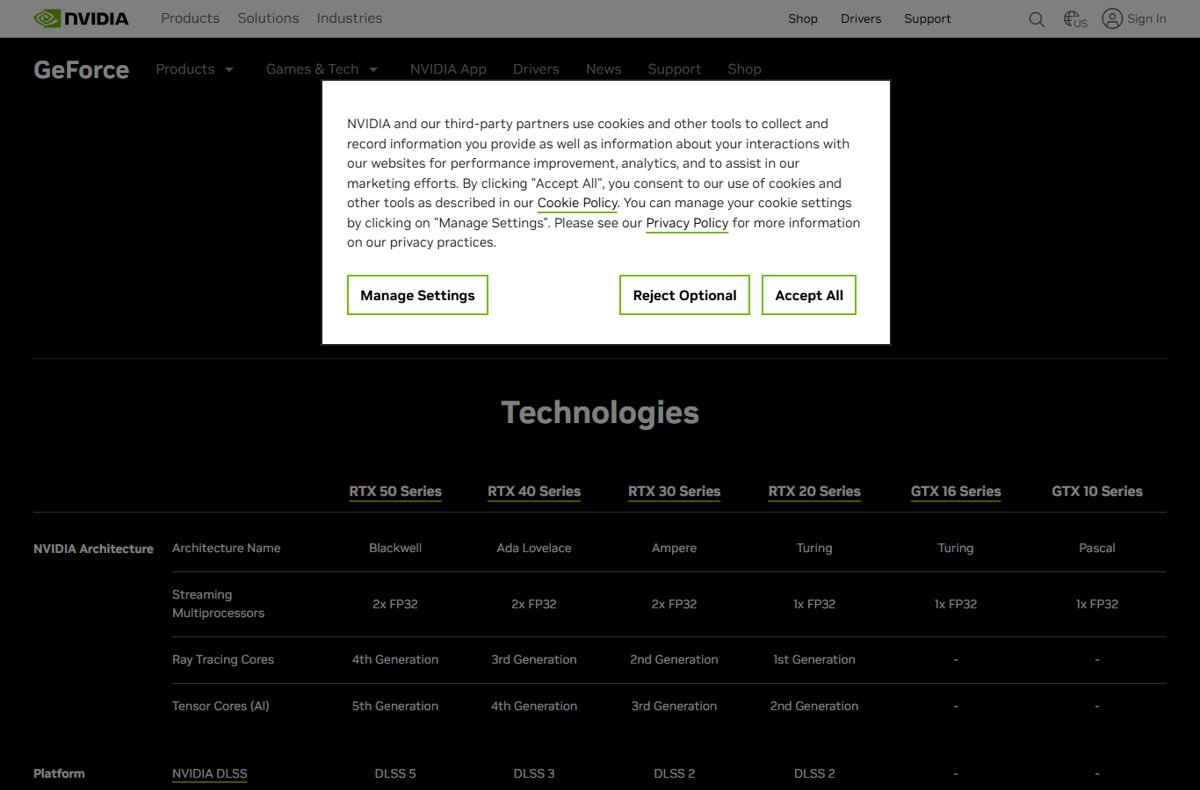
The GTX 16 Series uses Turing, the same architecture as the RTX 20 Series, but without ray tracing or Tensor cores. It is the last GTX line.
| Model | CUDA cores | Boost clock | Memory | Bus width | Card power | Min. PSU |
|---|---|---|---|---|---|---|
| GTX 1660 Ti | 1,536 | 1,770 MHz | 6 GB GDDR6 | 192-bit | 120 W | 450 W |
| GTX 1660 Super | 1,408 | 1,785 MHz | 6 GB GDDR6 | 192-bit | 125 W | 450 W |
| GTX 1660 | 1,408 | 1,785 MHz | 6 GB GDDR5 | 192-bit | 120 W | 450 W |
| GTX 1650 Super | 1,280 | 1,725 MHz | 4 GB GDDR6 | 128-bit | 100 W | 350 W |
| GTX 1650 (G5) | 896 | 1,665 MHz | 4 GB GDDR5 | 128-bit | 75 W | 300 W |
| GTX 1650 (G6) | 896 | 1,590 MHz | 4 GB GDDR6 | 128-bit | 75 W | 300 W |
| GTX 1630 | 512 | 1,785 MHz | 4 GB GDDR6 | 64-bit | 75 W | 300 W |
The reference GTX 1650 (G5) has HDMI 2.0b and DL-DVI-D but no DisplayPort, so check the outputs before you plan to use DisplayPort on the card. Partner cards can differ from these reference specs.
Performance Metrics
Without benchmarks, the spec sheet still tells you a lot. Compare these numbers within one series or architecture; across architectures, a newer CUDA core does more work per clock.
| Metric | What it tells you | Example |
|---|---|---|
| CUDA cores | Parallel processing units; more means faster within one architecture | GTX 1660 Ti 1,536 vs GTX 1650 896 |
| Boost clock | Typical speed under gaming load | 1,770 MHz on the GTX 1660 Ti |
| Memory size | How large textures and resolutions fit before the card runs out of room | 6 GB on the GTX 1660 series |
| Memory type and bus width | Bandwidth: GDDR6 and a wider bus move data faster | GTX 1660 Super (GDDR6) vs GTX 1660 (GDDR5) |
| Card power | Heat and the power supply you need | 75 W GTX 1650 needs a 300 W system PSU |
Verdicts: Which GTX Card Suits Which User
These verdicts follow from Nvidia's published specs and feature lists, not hands-on testing.
| Your situation | Verdict | Why |
|---|---|---|
| You want ray tracing or DLSS | Skip GTX; look at RTX | No GTX card has RT or Tensor cores, and none support DLSS or DirectX 12 Ultimate |
| Budget 1080p gaming with current drivers | GTX 1650 Super or a GTX 1660 model | Turing cards still get Game Ready drivers and have 4-6 GB of memory |
| Small PC with no power connector | Check the card; reference 16 Series cards list a 6-pin or 8-pin connector | Card power is 75 W to 125 W |
| VR headset | GTX 1650 Super or higher, or GTX 1060 or higher | Nvidia's VR Ready list |
| You own a GTX 600, 700 or older card | Plan an upgrade | Only legacy drivers remain for these architectures |
Compatibility and Future-Proofing
| Check | GTX status | What it means |
|---|---|---|
| Game Ready drivers | GTX 16 yes; GTX 10 not listed | New game fixes and optimizations stop on older series |
| Linux drivers | Everything before GTX 16 is on a legacy branch (580, 470, 390 or 340.xx) | Legacy branches only add support for new kernels and X server versions |
| DirectX 12 Ultimate | Not supported on any GTX card | Games that require it will not run |
| PCI Express | Gen 3 on GTX 10 and 16 | Works in newer Gen 4 and Gen 5 slots at Gen 3 speed |
| AV1 video decode | Not supported on GTX 10 or 16 | AV1 video falls back to the CPU |
How to check which GTX card is in your PC
Before matching your card to the lists above, confirm the exact model. The full set of methods is in the guide to check which graphics card you have.
- Press Ctrl + Shift + Esc to open Task Manager.
- Select the Performance tab.
- Select GPU in the left column.
- Read the model name in the top-right corner, such as NVIDIA GeForce GTX 1660 Super.
- Find that model in the tables above to see its series, architecture and driver status.
Frequently asked questions
What is the newest GTX graphics card?
The GTX 16 Series is the newest GTX line, made up of the GTX 1630, 1650, 1650 Super, 1660, 1660 Super and 1660 Ti. Nvidia's newer cards all use the RTX name.
What is the best Nvidia GTX card?
In the current GTX 16 Series, the GTX 1660 Ti has the most CUDA cores (1,536). Among older series, the GTX 1080 Ti tops the 10 Series and the GTX 980 Ti was the Maxwell flagship.
What Nvidia graphics card do I have?
Open Task Manager with Ctrl + Shift + Esc, select Performance and then GPU. The model name, such as NVIDIA GeForce GTX 1060 6GB, appears at the top right.
What is the difference between GTX and RTX?
RTX cards have ray tracing cores and Tensor cores and support DLSS and DirectX 12 Ultimate. GTX cards have none of these, even the Turing-based GTX 16 Series.
How do I get an Nvidia graphics card?
Buy a current card from Nvidia's store or an authorized retailer, or buy a prebuilt PC or laptop with one. Nvidia lists older GTX models such as the 900 Series as no longer in stock.
Where can I buy an Nvidia GTX graphics card?
GTX 16 Series cards are made by Nvidia's board partners and sold through retailers. Nvidia marks older series such as the 900 Series as no longer in stock, so check driver support before buying one used.
Are there GTX laptop graphics cards?
Yes. Laptop GTX chips carry an M suffix, such as the GTX 970M, or a Max-Q Design label, such as the GTX 1070 with Max-Q Design. The GTX 800 names exist only as laptop chips.
What are the GTX graphics cards in order?
From oldest to newest: GTX 200, 400, 500, 600, 700, 900, 10 and 16 Series. Within a series, a higher tier number such as 80 sits above 70, 60 and 50.