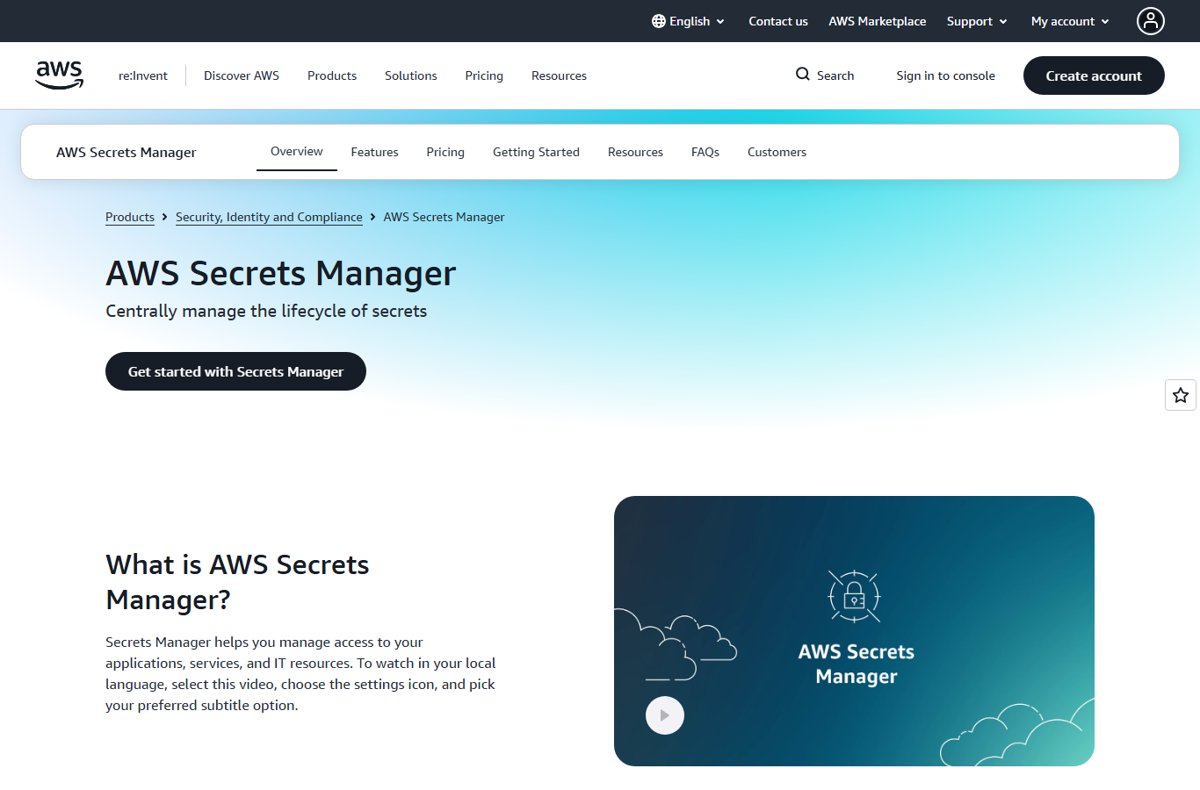
AWS Secrets Manager is an AWS service that stores, encrypts, retrieves and rotates database credentials, API keys, OAuth tokens and other secrets, so your code fetches them at runtime instead of hard-coding them.
This covers creating and reading a secret, how encryption and rotation work, Region replication, pricing as of October 2026, quotas, the alternatives, and fixes for the errors AWS documents.
How to use AWS Secrets Manager: store your first secret
Your IAM identity needs the permissions in the SecretsManagerReadWrite managed policy. The console is the quickest way to store a secret.
- Open the Secrets Manager console at
https://console.aws.amazon.com/secretsmanager/in the Region where your app runs. - Choose Store a new secret.
- Under Secret type, pick the database credential type for a database, or Other type of secret for API keys and tokens.
- Enter the values as Key/value pairs, or switch to the Plaintext tab and paste any format up to 65,536 bytes.
- Leave Encryption key on aws/secretsmanager unless you need cross-account access or your own key policy, then choose Next.
- Type a Secret name (1-512 characters: letters, numbers and
/_+=.@-) and a Description, then choose Next. - Leave rotation off for now on Configure rotation, choose Next, review the details and choose Store.
Choose the refresh button if the new secret does not appear in the list straight away. Do not put sensitive data in tags, because tags are not encrypted.
What is AWS Secrets Manager and what does it do?
Secrets Manager replaces a password in source code with a runtime call that fetches it. Anyone who can read the code, the container image or the config file no longer sees the credential.
| Core feature | What it does |
|---|---|
| Encrypted storage | Encrypts every secret value at rest with an AWS KMS key and sends it to you over TLS |
| Runtime retrieval | Apps, Lambda functions, containers and CI jobs fetch the current value through the API, SDKs or CLI |
| Automatic rotation | Changes the credential on a schedule as often as every four hours, in the secret and in the database or service |
| Versioning | Keeps the current, previous and pending versions with the labels AWSCURRENT, AWSPREVIOUS and AWSPENDING |
| Access control | IAM policies, resource policies on each secret and attribute-based access control decide who can read or change it |
| Multi-Region replication | Copies a secret to other Regions and keeps replicas in sync with the primary |
| Auditing | Logs every create, read, rotate and delete call to AWS CloudTrail |
| Managed secrets | Amazon RDS, Aurora, Redshift and other services create and rotate their own admin secrets for you |
AWS points other secret types to other services: AWS credentials to IAM, encryption keys to AWS KMS, SSH keys to EC2 Instance Connect, and private keys and certificates to AWS Certificate Manager.
How does AWS Secrets Manager work?
Each secret is a value plus metadata. The value is encrypted with envelope encryption, and every change creates a new version.
| Stage | What happens |
|---|---|
| You store or change a value | Secrets Manager asks AWS KMS for a new 256-bit AES data key, encrypts the value with it outside KMS, and keeps only the encrypted copy of the key |
| The secret gets an ARN | Format arn:aws:secretsmanager:<Region>:<AccountId>:secret:SecretName- plus six random characters, so a recreated secret never inherits the old one's access |
| An app asks for the value | Secrets Manager checks IAM and resource policies, has KMS decrypt the data key, decrypts the value and returns it over TLS |
| Rotation runs | A new version is written with the AWSPENDING label, tested, then moved to AWSCURRENT while the old one becomes AWSPREVIOUS |
| Old versions pile up | Unlabelled versions are deprecated and removed once a secret has more than 100, but never within 24 hours of creation |
| Every call | CloudTrail records it as a management event |
None of the Secrets Manager APIs return the encrypted secret or the encrypted data key. A retrieval returns the AWSCURRENT version unless you ask for another stage.
How do I access AWS Secrets Manager: console, CLI, SDK or API?
| Access route | Use it when | Note |
|---|---|---|
| Secrets Manager console | You manage a few secrets by hand | Almost every task is available in the browser |
| AWS CLI | You script tasks or work from a terminal | Commands sit under aws secretsmanager; shell history can capture secret values |
| AWS Tools for Windows PowerShell | You automate from PowerShell on Windows | Second official command-line tool set |
| AWS SDKs | Your application reads secrets at runtime | C++, Go, Java, JavaScript, Kotlin, .NET, PHP, Python (Boto3), Ruby, Rust, SAP ABAP and Swift; requests are signed and retried for you |
| HTTPS Query API | You cannot use an SDK | Call secretsmanager.<region>.amazonaws.com directly and sign every request yourself |
| Lambda extension | A Lambda function needs secrets | The AWS Parameters and Secrets Lambda Extension fetches and caches values without an SDK |
Endpoints support IPv4 and IPv6, TLS 1.2 and 1.3, and post-quantum TLS in every Region except the China Regions. FIPS endpoints exist in some Regions.
Get a secret value with the AWS Secrets Manager CLI
The caller needs the secretsmanager:GetSecretValue permission. Replace MyTestSecret with your secret's name or full ARN.
aws secretsmanager get-secret-value --secret-id MyTestSecretReturns the AWSCURRENT version of the secret. Add --version-stage AWSPREVIOUS to read the version that was current before the last rotation.
You should see: A JSON block with ARN, Name, VersionId, SecretString, VersionStages showing AWSCURRENT, and CreatedDate.
To read several secrets in one call, use aws secretsmanager batch-get-secret-value --secret-id-list MySecret1 MySecret2. It needs secretsmanager:BatchGetSecretValue plus GetSecretValue on each secret.
AWS Secrets Manager CLI commands: create, list, describe and delete secrets
Replace MyTestSecret with your own secret name or ARN. If you run the AWS CLI in the Windows Command Prompt, quoting rules for JSON differ from Linux and macOS, so passing the value from a file with file:// avoids escaping problems.
| Task | Command |
|---|---|
| Create a secret from a JSON file | aws secretsmanager create-secret --name MyTestSecret --secret-string file://mycreds.json |
| List secrets in the Region | aws secretsmanager list-secrets |
| List secrets with Test in the name | aws secretsmanager list-secrets --filters Key="name",Values="Test" |
| Show a secret's metadata | aws secretsmanager describe-secret --secret-id MyTestSecret |
| Replicate to another Region | aws secretsmanager replicate-secret-to-regions --secret-id MyTestSecret --add-replica-regions Region=eu-west-3 |
| Schedule deletion after 7 days | aws secretsmanager delete-secret --secret-id MyTestSecret --recovery-window-in-days 7 |
| Cancel a scheduled deletion | aws secretsmanager restore-secret --secret-id MyTestSecret |
Typing a password straight into --secret-string leaves it in shell history. AWS recommends writing it to a file, passing the file, then deleting the file.
AWS Secrets Manager rotation: turn on automatic rotation
These steps cover rotation by Lambda function for a non-database secret. You need iam:CreateRole and iam:AttachRolePolicy, and a Lambda rotation function, which you can deploy from the SecretsManagerRotationTemplate application in the Lambda console where AWS Serverless Application Repository is supported.
- Open the Secrets Manager console and choose your secret on the Secrets page.
- In the Rotation configuration section, choose Edit rotation.
- Turn on Automatic rotation.
- Under Rotation schedule, use the Schedule expression builder or type a Schedule expression such as
rate(30 days); times are UTC. - Optionally set Window duration, for example
3h, so rotation only runs inside that window. - Select Rotate immediately when the secret is stored if you want the first rotation now rather than on schedule.
- Under Rotation function, choose your Lambda function, then choose Save.
The function's execution role needs access to the secret and the target service, and the function's resource policy must grant lambda:InvokeFunction to Secrets Manager. AWS recommends the aws:SourceAccount condition key there.
AWS Secrets Manager rotation types and schedules explained
| Rotation type | Used for | Lambda function? |
|---|---|---|
| Managed rotation | Admin credentials created by Amazon RDS, Aurora, DocumentDB and Redshift, plus Amazon ECS Service Connect TLS certificates | No; usually completes within one minute |
| Managed external secrets | Secrets held by Secrets Manager partner applications | No |
| Rotation by Lambda function | Every other secret, including your own databases and third-party API keys | Yes, billed at Lambda rates |
A Lambda rotation runs four steps: create_secret, set_secret, test_secret and finish_secret. If a step fails, Secrets Manager retries the whole rotation during the open rotation window.
Schedules use rate() or cron() expressions, from every four hours up to 999 days, with a window of at least one hour. Single user and alternating users are the two Lambda strategies, and AWS suggests alternating users for application logins that need the highest availability.
Replicate AWS Secrets Manager secrets to another Region
Secrets are regional. Replication copies the encrypted value, tags and resource policies to other enabled Regions, and rotation in the primary Region updates every replica.
- Open the Secrets Manager console and choose your secret.
- On the Replication tab, choose Replicate secret, or Add Region if it already has replicas.
- In Add replica regions, pick the AWS Region.
- Optionally choose an Encryption key that lives in the replica Region.
- Choose Replicate and watch Replication status for each Region on the details page.
A replica's ARN matches the primary except for the Region. GovCloud (US) and China Regions can only replicate among themselves, and you can still read a secret from another Region without replicating it by calling that Region's endpoint.
AWS Secrets Manager integrations with Lambda, RDS, EKS and Parameter Store
| Service or tool | How it uses Secrets Manager |
|---|---|
| Amazon RDS, Aurora, Redshift, DocumentDB | Create and rotate their own admin secrets as managed secrets |
| AWS Lambda | Reads cached secrets through the AWS Parameters and Secrets Lambda Extension; needs a VPC endpoint when the function runs in a VPC |
| Amazon EKS, ECS and EC2 | EKS workloads can retrieve secrets directly; the AWS Workload Credentials Provider standardises secret use across Lambda, ECS, EKS and EC2 |
| AWS Systems Manager Parameter Store | References a Secrets Manager secret as a parameter; the secret ID needs a leading forward slash |
| AWS CloudFormation and AWS CDK | Create secrets and rotation as part of your infrastructure templates |
| GitHub and GitLab jobs, AWS Batch, IoT Greengrass | Retrieve secrets during builds, batch jobs and on edge devices |
| Amazon EventBridge, AppFlow, DataSync, Direct Connect | Store their connection secrets in Secrets Manager under a service ID prefix such as events or appflow |
| AWS CloudTrail, CloudWatch, Config, GuardDuty | Log, alarm on, audit and watch secret access for threats |
AWS Secrets Manager pricing and cost examples
Prices below are from the AWS pricing page as checked on 9 October 2026. You pay per secret stored and per API call, with no upfront fee.
| Cost item | Price (October 2026) |
|---|---|
| Each secret | $0.40 per secret per month, prorated by the hour for short-lived secrets |
| API calls | $0.05 per 10,000 calls |
| New versions created by rotation | No charge |
| Secrets scheduled for deletion | No charge |
| AWS managed key aws/secretsmanager | No charge |
| Customer managed KMS key | $1 per key per month plus KMS request charges after 20,000 free requests a month |
| Lambda rotation function | Standard Lambda pricing |
| Example: 15 secrets, about 4,040 calls a month | $6.02 a month |
| Example: 1,500 secrets used 20 times a day | $604.50 a month |
Use cost allocation tags on secrets to split the bill by project, and the AWS Pricing Calculator to estimate a full architecture.
AWS Secrets Manager vs Parameter Store vs KMS: which to use
These services overlap, but AWS's own guidance draws clear lines between them.
| Your situation | Use this | Why |
|---|---|---|
| Database credentials, API keys or tokens that should rotate | AWS Secrets Manager | Only option with automatic rotation, native database integrations and cross-Region replication |
| Plain configuration such as endpoint URLs or AMI IDs | Parameter Store standard parameters | No extra charge, up to 10,000 parameters of 4 KB each per Region |
| Encrypted config that never rotates | Parameter Store SecureString | KMS encryption without per-secret fees; advanced parameters cost $0.05 each a month |
| Encryption keys for your own data | AWS KMS | KMS holds keys and does crypto operations; it does not store app credentials |
| AWS access for code running on AWS | IAM roles | Temporary credentials at no extra cost, with nothing to store |
| Workload runs on Microsoft Azure | Azure Key Vault | Azure's own store for secrets, keys and certificates |
AWS Secrets Manager security best practices
| Practice | How to apply it |
|---|---|
| Remove hard-coded secrets | Scan code with the Amazon CodeGuru Reviewer secrets detector or Amazon Q, then move what it finds into Secrets Manager |
| Pick the right key | Use aws/secretsmanager by default; use a customer managed key with kms:ViaService set to secretsmanager.<region>.amazonaws.com for cross-account access |
| Grant least privilege | Scope IAM and resource policies to named secrets, and require secretsmanager:BlockPublicPolicy on PutResourcePolicy |
| Rotate | Turn on automatic rotation; use a low-privilege app user and alternating users rather than the master user |
| Cache values | Use the client-side caching libraries for Java, Python, .NET, Go or Rust instead of calling the API on every request |
| Keep traffic private | Reach Secrets Manager through an interface VPC endpoint and restrict with aws:SourceVpc or aws:SourceVpce |
| Be careful with IP conditions | An aws:SourceIp rule can block Lambda rotation, which calls from AWS-internal addresses |
| Monitor | Log with CloudTrail, alarm in CloudWatch, check compliance with AWS Config and detect threats with GuardDuty |
AWS Secrets Manager use cases
| Use case | How Secrets Manager fits |
|---|---|
| Web app database passwords | The app refreshes its connection pool from the secret, and weekly rotation changes the password without a redeploy |
| Short-lived tokens for microservices | Store tokens for an hour at a time; per-secret cost is prorated hourly |
| Third-party API keys and OAuth tokens | One encrypted, audited place instead of keys spread across config files |
| Cross-account access | A customer managed KMS key plus a resource policy lets another AWS account read the secret |
| Multi-Region disaster recovery | Replicas keep credentials available in a standby Region |
| CI/CD pipelines | GitHub or GitLab jobs fetch deploy credentials at run time instead of storing them in the repository |
AWS Secrets Manager limits, quotas and limitations
| Limit | Default value | Adjustable? |
|---|---|---|
| Secrets per Region per account | 500,000 | No |
| Secret value size | 65,536 bytes | No |
| Versions per secret | 100 | No |
| Staging labels across all versions | 20 | No |
| Resource policy length | 20,480 characters | No |
| GetSecretValue requests | 10,000 per second | No |
| DescribeSecret requests | 40,000 per second | No |
| ListSecrets and BatchGetSecretValue requests | 100 per second each | No |
| CreateSecret, DeleteSecret and most write calls | 50 per second | No |
Other limits worth planning for: the minimum rotation interval is four hours, a deleted secret stays recoverable for at least seven days unless you force deletion, and you cannot delete a primary secret while replicas exist. Cross-account calls count against the caller's account, not the owner's.
Delete an AWS Secrets Manager secret immediately or restore it
Deletion is deliberately slow. By default a deleted secret becomes inaccessible at once but stays recoverable for a 7 to 30 day window, 30 days if you set nothing.
- Delete any replicas first: open the primary secret, choose the replica under Replicate Secret, then Actions > Delete Replica.
- Open the secret, choose Actions > Delete secret.
- Enter the Waiting period in days and choose Schedule deletion.
- To delete with no recovery window, run
aws secretsmanager delete-secret --secret-id MyTestSecret --force-delete-without-recoveryinstead; this cannot be undone. - To restore, choose Preferences, select Show secrets scheduled for deletion, open the secret and choose Cancel deletion twice.
If you are unsure whether anything still uses the secret, set a CloudWatch alarm on access attempts during the recovery window. Deleting needs secretsmanager:ListSecrets and secretsmanager:DeleteSecret.
Check that an AWS Secrets Manager secret and rotation work
- Run
aws secretsmanager get-secret-value --secret-id MyTestSecretwith the same role your app uses. - Confirm the output has a
SecretStringwith your keys andVersionStagesshowingAWSCURRENT. - After a rotation, run the same command with
--version-stage AWSPREVIOUSand confirm it returns the older value. - Run
aws secretsmanager describe-secret --secret-id MyTestSecretto review the secret's metadata, including any owning service. - Open CloudTrail event history and check for the
GetSecretValueorRotateSecretevents you expect.
Changes are eventually consistent, so a value read seconds after an update or rotation can still be the old one.
AWS Secrets Manager errors and how to fix them
"Access denied" when reading or creating a secret
The IAM user or role lacks the Secrets Manager or KMS permission, or a policy condition such as time or IP address is not met.
- Check the identity's IAM policy for the action named in the error, such as
secretsmanager:GetSecretValue. - For a customer managed key, confirm the identity can use that KMS key.
- For temporary credentials, confirm they have not expired and that the underlying role has the permission.
A new or changed value does not show up yet
Secrets Manager is eventually consistent and caches data.
- Wait briefly and read the secret again.
- Design callers to tolerate a short delay after updates and rotation.
"Connection reset by peer"
AWS closed an idle or reused connection, which is normal occasionally.
- Update the AWS SDK or CLI and keep default retries on.
- Cache secret values on the client so the app opens fewer connections.
- If it persists, check the AWS Health Dashboard and your VPC endpoint, proxy, firewall and DNS path.
"Cannot generate a data key with an asymmetric KMS key"
The secret was given an asymmetric KMS key.
- Choose a symmetric encryption KMS key or aws/secretsmanager.
- Create the secret again with that key.
The CLI cannot find a secret from a partial ARN
The secret name ends in a hyphen and six characters, which looks like a full ARN.
- Pass the secret's name or its complete ARN to
--secret-id. - Run
aws secretsmanager list-secretsto copy the exact ARN.
"This secret is managed by an AWS service"
Another service, such as Amazon RDS, owns the secret.
- Run
describe-secretand read theOwningServicefield, or check the service prefix in the name. - Change the secret through that service instead.
AWS Secrets Manager future trends: managed external secrets and post-quantum TLS
The current AWS documentation lists several capabilities that cut down on custom Lambda code and hand more secret handling to AWS.
| Feature | What it adds |
|---|---|
| Managed external secrets | Stores and rotates secrets held by Secrets Manager partner applications without a Lambda function |
| AWS Workload Credentials Provider | One way to consume secrets across Lambda, ECS, EKS and EC2 |
| Post-quantum TLS | Supported on endpoints in all Regions except the China Regions |
| BatchGetSecretValue | Reads a group of secrets in one call, selected by a name list or a filter |
| AI coding agent retrieval | Listed by AWS as a supported way to get secret values |
AWS Secrets Manager documentation: references and further reading
- What is AWS Secrets Manager? — Official user guide start page
- AWS Secrets Manager pricing — Current per-secret and per-call prices with examples
- AWS Secrets Manager FAQs — AWS answers on rotation, security and billing
- Rotation schedules — rate() and cron() syntax and rotation windows
- AWS Secrets Manager quotas — Every limit and request rate
- AWS Secrets Manager best practices — Key choice, caching, access control and monitoring
- Troubleshooting AWS Secrets Manager — Documented errors and fixes
- AWS CLI secretsmanager reference — Full syntax and sample output for each command
AWS Secrets Manager FAQ
What is AWS Secrets Manager?
AWS Secrets Manager is an AWS service for storing, retrieving and rotating secrets such as database credentials, API keys and OAuth tokens. It encrypts each value with AWS KMS, controls access with IAM, and lets applications fetch credentials at runtime instead of keeping them in source code.
What does AWS Secrets Manager do?
It keeps secrets encrypted in one place, returns them to authorised callers over TLS, rotates them on a schedule, replicates them across Regions and logs every access in CloudTrail. The main job is removing hard-coded passwords and long-lived credentials from code and configuration files.
How does AWS Secrets Manager work?
Each secret value is encrypted with a unique AES-256 data key that AWS KMS generates and protects. When an authorised caller requests the secret, Secrets Manager decrypts it and returns the current version. Rotation writes a new version, tests it, then promotes it to AWSCURRENT.
Is AWS Secrets Manager free?
No. As of October 2026 it costs $0.40 per secret per month plus $0.05 per 10,000 API calls. New AWS customers get up to $200 in Free Tier credits that can be spent on Secrets Manager, and the aws/secretsmanager encryption key itself has no charge.
How do I access AWS Secrets Manager?
Sign in to the AWS Management Console and open https://console.aws.amazon.com/secretsmanager/, or use the AWS CLI commands under aws secretsmanager, AWS Tools for Windows PowerShell, an AWS SDK or the HTTPS Query API. Your IAM identity needs Secrets Manager permissions for each action.
How do I use AWS Secrets Manager in my application?
Store the credential as a secret, give the application's IAM role secretsmanager:GetSecretValue on it, and replace the hard-coded value with an SDK call or caching library that fetches the secret at runtime. Lambda functions can use the AWS Parameters and Secrets Lambda Extension instead of an SDK.
Is AWS Secrets Manager global or regional?
It is regional. Each secret lives in one Region and its ARN contains that Region. You can replicate a secret to other Regions, where rotation in the primary updates every replica, or call another Region's endpoint to read a secret without replicating it.
Is AWS Secrets Manager set up per account?
Yes. Secrets belong to one AWS account and Region, and the 500,000-secret quota applies per Region per account. Another account can read a secret only if it is encrypted with a customer managed KMS key and a resource policy grants that account access.
What is the Azure equivalent of AWS Secrets Manager?
Azure Key Vault is Microsoft's equivalent. It stores tokens, passwords, certificates, API keys and other secrets, and also manages encryption keys and TLS certificates. Choose the store that belongs to the cloud where your workload runs.
What is the difference between AWS Secrets Manager and Parameter Store?
Secrets Manager rotates credentials automatically, replicates across Regions and charges $0.40 per secret a month. Parameter Store standard parameters cost nothing extra but never rotate. AWS recommends Parameter Store for configuration data and Secrets Manager for credentials, API keys and tokens.
How do I delete an AWS Secrets Manager secret immediately?
Run aws secretsmanager delete-secret --secret-id <name> --force-delete-without-recovery. The secret is deleted with no recovery window and cannot be restored. Remove any replicas first, because a primary secret with replicas cannot be deleted.
How often can AWS Secrets Manager rotate a secret?
As often as every four hours, and as rarely as every 999 days. You set the schedule with a rate() or cron() expression in UTC, plus an optional rotation window of at least one hour during which Secrets Manager performs the rotation.
Is AWS Secrets Manager worth it?
Use AWS Secrets Manager for any credential your AWS workloads use that should rotate or be audited, and keep plain configuration in Parameter Store standard parameters. At $0.40 per secret a month (October 2026), automatic rotation, CloudTrail auditing and Region replication cost far less than building them yourself, while Parameter Store covers non-secret settings at no extra charge.


![How to find word count in Microsoft Word [updated 2026]](https://techdows.com/wp-content/uploads/2026/10/Word-Review-tab-with-the-Word-Count-menu-and-Show-Word-Count-ticked-600x252.jpg)